
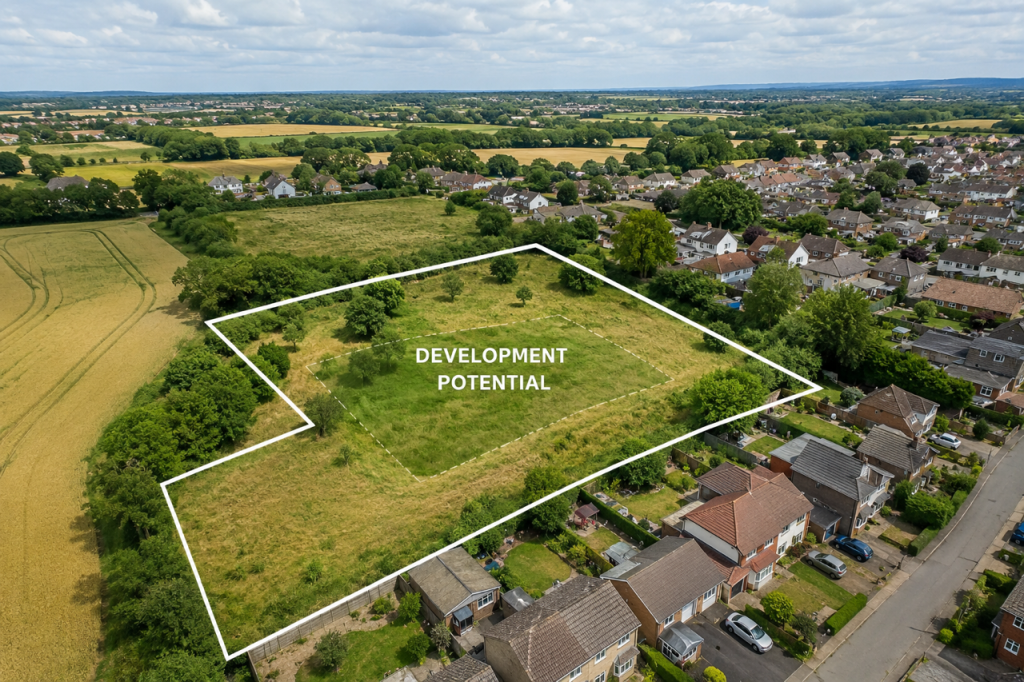
Developers generally value land by looking at what the site could realistically be developed into, what the completed development could be worth, and what it would cost and risk to deliver. They may then use a development appraisal or residual valuation to work backwards to an indication of what they can afford to pay for the land. The figure is therefore driven by the economics of the particular site rather than a simple price per acre.
If a property developer approaches you about your land, you may naturally want to know how they have decided what the land is worth.
You may also receive very different opinions from different developers. One developer might make an offer that is significantly different from another, even though they are looking at exactly the same piece of land.
This does not necessarily mean that one of them has made a mistake.
Developers can make different assumptions about what can be built, what the completed properties might sell for, development costs, the timescale involved and the level of risk they are prepared to take.
Understanding those factors can help a landowner make better sense of a developer’s approach.
Developers Do Not Usually Value Land Simply by the Acre
One of the most important things to understand is that development land is not normally valued simply by taking the number of acres and multiplying it by a standard price.
The more important question is:
A developer will consider the potential development, the value of the completed scheme and the costs and risks involved in getting from the current site to that completed development.
This is why two sites of the same size can have very different values.
It is also why a price per acre quoted for another site should not automatically be treated as evidence of what your own land is worth.
What Does a Developer Look at When Assessing Land?
Before deciding what they may be able to pay, a developer will typically consider a number of different factors.
- the location of the site;
- the current planning position;
- the potential development capacity;
- the likely type of development;
- local property values and market demand;
- access and highway requirements;
- availability of services and infrastructure;
- construction and professional costs;
- planning obligations and other contributions;
- finance and the development timescale;
- the risks associated with the planning process; and
- the return required for the developer to proceed.
These inputs are then used to assess whether a development is financially viable and what amount could potentially be available for the land.
Step 1: What Could Be Built on the Land?
The first question is often about the site’s development potential.
This is not simply a question of how many acres are available. A developer needs to understand what form of development might realistically be achievable.
This could involve considering:
- the number of potential homes or other buildings;
- the size and type of development;
- the site’s shape and layout;
- access arrangements;
- planning policy;
- surrounding development;
- environmental and physical constraints; and
- whether infrastructure can support the proposed development.
A larger site does not automatically mean a higher value if significant parts of it cannot contribute effectively to the development.
Step 2: What Could the Completed Development Be Worth?
Once a potential development has been considered, the developer needs to estimate what the completed scheme could be worth.
For residential development, this will generally involve assessing the likely sales values of the completed homes.
This is commonly referred to as Gross Development Value (GDV).
Market evidence is important here. The developer may consider recent sales, comparable properties, local demand, property type, specification and location when estimating the value of the completed scheme.
Government guidance states that site-specific viability assessments should use appropriate market evidence rather than relying simply on average figures where evidence for the particular site or comparable developments is available. :contentReference[oaicite:2]{index=2}
Step 3: What Will It Cost to Develop the Site?
The potential value of the finished development is only one side of the calculation.
The developer also needs to consider the costs involved in creating it.
These may include:
- construction costs;
- professional fees;
- planning costs;
- highways and access works;
- infrastructure and utility works;
- planning obligations and contributions;
- finance costs;
- marketing and sales costs;
- legal costs; and
- contingency and other project costs.
The costs can be particularly important where a site has unusual access requirements, infrastructure requirements, contamination, difficult ground conditions or other abnormal development costs.
Government’s current land-value guidance specifically warns that abnormal and infrastructure costs can materially affect the value of individual sites. :contentReference[oaicite:3]{index=3}
Step 4: How Much Return Does the Developer Need?
A developer is taking on financial and planning risk, so the appraisal also needs to allow for the return required to justify undertaking the project.
The appropriate level can vary depending on the nature, complexity and risk profile of the development.
This is one reason why two developers can look at the same site and arrive at different figures.
Their financing arrangements, development experience, construction assumptions, intended product and appetite for risk may not be identical.
Step 5: The Developer Works Back to the Land Value
Once the potential development value and the costs have been considered, the developer can work backwards to establish an indication of the amount that can be allocated to the land.
Gross Development Value − Development Costs − Developer Return = Residual Land Value
GOV.UK describes residual land value as the amount a developer can afford to pay for land while keeping the project viable. RICS similarly describes the residual method as deriving land value from the value of the completed development after deducting the costs of undertaking the development, including an allowance for developer profit. :contentReference[oaicite:4]{index=4}
This is a simplified explanation. Real development appraisals can contain many more assumptions, and the timing of costs and income can also become important on larger or more complex schemes.
Why Can Two Developers Offer Different Prices for the Same Land?
It is possible for two developers to assess the same site and arrive at different figures.
This can happen because their assumptions are different.
One developer may believe that a higher-density scheme is achievable.
Another may take a more conservative view of the planning position.
One may have lower construction or finance costs.
Another may be prepared to accept a different level of risk or return.
RICS notes that residual valuations can be highly sensitive to relatively small changes in their input assumptions. This is why the assumptions behind a land valuation matter just as much as the final figure. :contentReference[oaicite:5]{index=5}
Does Planning Permission Affect How Developers Value Land?
Yes. The planning position can have a significant effect because it changes the level of certainty around what can be developed.
However, planning permission does not automatically translate into a particular percentage increase in value.
The detail of the permission matters, including the number and type of units, conditions, obligations, infrastructure requirements and whether the approved scheme is financially viable.
For a more detailed explanation, read: How Much Does Planning Permission Add to Land Value?
What Happens If the Land Does Not Have Planning Permission?
Land does not necessarily need an existing planning permission to attract developer interest.
A developer may consider land where there is a realistic opportunity to secure planning permission or otherwise establish a valuable alternative use.
In that situation, however, the developer is taking on additional planning risk and that risk can affect the price they are prepared to pay.
The important distinction is between land that might theoretically be developed and land where there is a credible and supportable development opportunity.
What Could Your Land Be Worth?
Understanding development value starts with the individual site. Our free land assessment provides an initial view of your land’s location, planning position and potential development opportunity.
Get My Free Land Assessment →What Should a Landowner Ask About a Developer’s Valuation?
If a developer has approached you, you do not necessarily need to know every detail of their financial model. However, it can be useful to understand the basis of their proposal.
Questions you may wish to ask include:
- What development do you believe is achievable?
- What planning assumptions have you made?
- How have you assessed the potential end values?
- Are there significant infrastructure or abnormal costs?
- What timescale are you assuming?
- Is the offer unconditional or subject to planning?
- Are there overage, clawback or other provisions in the proposed agreement?
- What other conditions would apply to the purchase?
Understanding the assumptions behind an offer can be just as important as looking at the headline price.
Is the Highest Developer Offer Always the Best Option?
The headline price is important, but it is not necessarily the only consideration when comparing proposals for development land.
The terms attached to an offer can affect both its value and the certainty of receiving the stated amount.
For example, a proposal may be subject to planning, have a long conditional period or include provisions that affect the eventual amount payable.
This is why a landowner should consider both the price and the structure of the proposed transaction.
Frequently Asked Questions
How do developers value land?
Developers generally consider what can realistically be developed, the potential value of the completed scheme, development costs, finance, planning risk and the return required to justify undertaking the project. These inputs can then be used in a development appraisal or residual valuation to assess what may be available for the land.
How do developers calculate land value?
In a simplified residual calculation, the potential value of the completed development is reduced by development costs and the required developer return. The remaining amount represents the residual land value within that appraisal.
Do developers use price per acre?
Price per acre can be used as a way of comparing land transactions, but it should not normally be treated as the sole method of establishing the value of a development opportunity. The development potential and economics of the particular site are important.
Why do developers offer different prices for the same land?
Developers may use different assumptions about planning, development capacity, property values, construction costs, finance, timescale and risk. These differences can produce different residual land values and therefore different offers.
Can a developer value land without planning permission?
Yes. A developer may assess land without planning permission where there appears to be a credible opportunity to obtain permission or establish another valuable development use. The additional planning risk will normally form part of the assessment.
Does planning permission automatically increase land value?
Planning permission can increase value by providing greater certainty about development, but the effect varies between sites. The detail of the permission, development costs, end values and remaining risks all matter.
What is residual land value?
Residual land value is an indication of the amount remaining for the land after allowing for the value of the completed development and the costs and developer return required to deliver it.
Can I find out how a developer arrived at an offer?
You can ask the developer about the assumptions behind their proposal, including the development they believe is achievable, expected end values, costs, planning assumptions and transaction terms. The amount of information a developer is prepared to provide will vary.
Related Landowner Guides
- How Much Is Development Land Worth Per Acre?
- How Much Does Planning Permission Add to Land Value?
- How Much Is My Land Worth to a Developer?
- Can I Sell My Land to a Developer?
Have a Question About Your Land?
If you’re unsure how the information applies to your particular site, contact Revive Estates Group for assistance.
Contact Us →