
The short answer
After you submit land to a Call for Sites, the council normally checks the information provided and then assesses the site alongside other potential development sites. The assessment can consider suitability, availability, achievability, development potential, infrastructure and other planning constraints. Some sites may progress towards potential allocation in the Local Plan, while others may not. Being submitted or assessed does not mean that planning permission will be granted or that the site will necessarily be allocated.
Written by the Revive Estates Group team — independent land development consultants helping landowners across the UK understand and unlock the development potential of their land, property and buildings.
What Happens After You Submit Land to a Call for Sites?
Submitting land to a Call for Sites is only the beginning of the process.
Once the submission period has closed, the council normally needs to identify, assess and compare the potential sites before deciding which ones could contribute towards its Local Plan strategy.
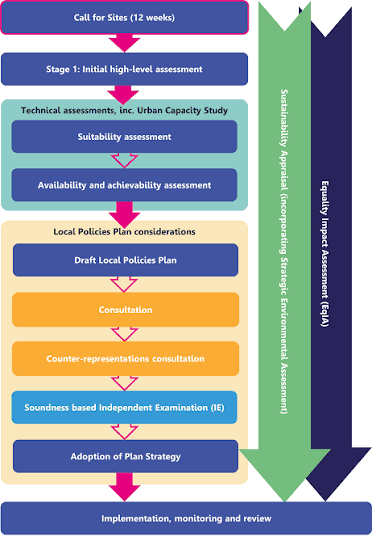
The current government guidance for England sets out a four-stage site-selection process:
- Stage 1 — Identifying sites
- Stage 2 — Assessing sites
- Stage 3 — Determining draft allocations
- Stage 4 — Confirming draft allocations
This means there can be a considerable difference between submitting a site and eventually having an adopted Local Plan allocation.
Stage 1: The Council Identifies Potential Sites
A Call for Sites forms part of the council’s process for identifying potential development sites.
The council does not necessarily rely solely on sites submitted by landowners.
Government guidance says councils can identify potential sites from a range of sources, including existing planning evidence, previous allocations, planning permissions and other information available to them.
A Call for Sites is particularly useful because it allows landowners, developers and other interested parties to put forward land that the council may not previously have identified.
At the end of this stage, the council has a list of potential sites that can move into further assessment.
What Happens to the Information You Submitted?
The council will normally use the information provided in your submission as part of its site assessment.
Current government guidance recommends collecting information such as:
- site location and boundary;
- site size;
- current and previous land use;
- planning history;
- previous promotion of the site;
- proposed development use;
- potential development scale;
- access arrangements;
- known constraints;
- availability;
- potential delivery timescale; and
- information relevant to viability and development costs.
The exact information requested will vary between councils.
The council may also seek additional information independently or contact the person who submitted the site if clarification is needed.
Will the Council Contact You After You Submit the Site?
It depends on the council and the information it needs.
Government guidance says councils should tell people who submit sites when their submission has been received, when it is expected to be assessed and whether further information may be requested.
A council may contact you if it needs to clarify matters such as:
- the proposed development;
- the site’s availability;
- access;
- development capacity;
- delivery timescale;
- planning history; or
- how known constraints could be addressed.
However, landowners should not assume that silence from the council means that the site has been rejected.
Some councils may carry out assessments using the information already submitted and only contact applicants where additional information is required.
Stage 2: How Does the Council Assess the Site?
This is where the process becomes much more important for the landowner.
The current government guidance says councils should assess potential sites against factors including:
- Suitability — is the site suitable for the proposed development?
- Availability — is the site genuinely available?
- Achievability — can the development realistically be delivered?
- Development potential — what scale and type of development could the site accommodate?
The council may also consider matters such as:
- access and transport;
- flood risk;
- ecology;
- heritage;
- landscape;
- infrastructure;
- relationship with existing settlements;
- planning policy;
- market conditions;
- viability;
- development timescales; and
- other local constraints.
The council can also use site visits, mapping, existing evidence and other sources of information when assessing a site.
What Does “Suitable, Available and Achievable” Mean?
Suitable
A suitable site is one where development could potentially take place in planning terms, having regard to its location, constraints, surrounding area and the proposed use.
A site might be available but unsuitable because of major environmental, infrastructure or location issues.
Available
Availability is about whether the land is genuinely available for the proposed development.
For example, the council may need to understand ownership, control of the land and whether there are other interests that could prevent or delay development.
Achievable
Achievability concerns whether the proposed development could realistically be delivered.
This can involve factors such as:
- development economics;
- abnormal costs;
- infrastructure requirements;
- access;
- market conditions;
- developer interest;
- delivery timescales; and
- other factors affecting implementation.
A site therefore needs more than simply a theoretical development opportunity.
Can the Council Change What You Proposed?
Yes, potentially.
The development proposal submitted by a landowner is not necessarily the final development capacity that the council will use in its assessment.
As the site is assessed, new information may indicate that:
- a smaller area is suitable;
- a different land use is more appropriate;
- a different development capacity should be considered;
- constraints reduce the developable area; or
- the proposed use does not represent the most efficient use of the land.
Current government guidance specifically recognises that site categories and assumptions may need to change as more information becomes available.
This is why the number of homes suggested on a Call for Sites form should not automatically be treated as the number that will ultimately be allocated or permitted.
Will the Council Visit the Site?
It may.
Site assessment can draw on information submitted by landowners as well as other evidence, mapping, data sources and site visits.
A site visit can help the council understand matters such as:
- the physical relationship with surrounding development;
- access;
- topography;
- landscape character;
- existing buildings and uses;
- surrounding land uses; and
- potential constraints.
However, not every council will visit every site at the same stage of the process.
What Happens If the Site Performs Well?
If a site performs well against the council’s assessment criteria, it may be taken forward for further consideration.
This still does not mean that it has been allocated.
The council may have more potentially suitable sites than it needs to meet its development requirements.
It therefore needs to compare the available options and decide which sites best support its overall planning strategy.
This is where the distinction between site assessment and site allocation becomes important.
Stage 3: How Does a Council Decide Which Sites to Allocate?
Once potential sites have been assessed, the council considers which sites should form part of its draft Local Plan allocations.
The current government guidance says councils should use planning judgement to select the sites that are most appropriate to meet the proposed plan’s vision and spatial strategy.
This means a site does not necessarily have to be the highest-scoring site in every individual category.
The council has to consider the overall planning strategy.
For example, a site may perform well in isolation but be less attractive if it would create an unsustainable pattern of development or conflict with the council’s preferred strategy for directing growth.
What Is a Proposed Allocation?
A proposed allocation is a site that the council is considering putting forward in its Local Plan for a specified development use.
Depending on the plan, an allocation may identify matters such as:
- the site’s development use;
- the number of homes or scale of development;
- access requirements;
- infrastructure requirements;
- open space;
- design principles; and
- other site-specific requirements.
However, a proposed allocation is still not the same as an adopted planning permission.
What Happens to the Site During Local Plan Consultation?
If the council decides to take a site forward as part of its draft plan, it will normally form part of the wider Local Plan process.
The plan will go through further stages of consultation and examination.
This gives interested parties an opportunity to comment on the emerging plan and proposed allocations.
At this stage, the site may attract comments relating to matters such as:
- traffic;
- infrastructure;
- landscape;
- flooding;
- ecology;
- settlement character;
- housing need; and
- the overall development strategy.
The fact that a site has been proposed for allocation does not mean that the final plan will necessarily contain exactly the same allocation.
When Does the Site Actually Become Allocated?
The important milestone is the adoption of the Local Plan.
Until the relevant plan has been adopted, the planning position can still change.
A site can therefore move through several stages:
- submitted through a Call for Sites;
- assessed;
- identified as potentially suitable;
- selected as a proposed allocation;
- considered through consultation and examination; and
- ultimately allocated in an adopted Local Plan.
Each stage represents a different level of planning certainty.
Does a Call for Sites Submission Mean Planning Permission Is Likely?
Not necessarily.
Even an adopted allocation does not remove the need to obtain planning permission for the development in most circumstances.
The eventual planning application will still need to address matters such as:
- layout;
- design;
- access;
- highways;
- drainage;
- ecology;
- landscape;
- heritage;
- affordable housing;
- infrastructure;
- open space; and
- other relevant planning requirements.
However, an adopted allocation can provide a much stronger planning framework than land with no allocation or identified development strategy.
What If the Council Rejects Your Site?
A site not being taken forward does not necessarily mean that it can never be developed.
The reason for rejection matters.
A site could be unsuccessful because:
- it is poorly located;
- there are significant constraints;
- infrastructure cannot support the proposed development;
- the council has more suitable sites;
- the proposed development does not fit the spatial strategy;
- the land is not considered available;
- the development is not considered achievable; or
- the council simply does not require that amount or type of land.
Some of these issues may be capable of being addressed.
Others may represent a fundamental problem.
This is why understanding the reason behind the decision is more useful than simply knowing that a site was unsuccessful.
Can You Update a Site After Submitting It?
Potentially.
The exact arrangements depend on the council and the stage of the Local Plan.
A council may contact submitters for additional information, and some authorities allow landowners to provide updates to previously submitted sites.
Changes could include:
- updated ownership information;
- changes to access;
- new planning information;
- additional technical evidence;
- changes in development capacity;
- progress with infrastructure; or
- changes to the site’s availability.
However, landowners should check the specific council’s rules rather than assuming that additional information can be submitted at any time.
What Does This Mean for Land Value?
The planning status of a site can have a significant effect on how the market views its potential.
There can be a major difference between:
- land with no identified development opportunity;
- land submitted through a Call for Sites;
- land being assessed as potentially suitable;
- land identified as a proposed allocation; and
- land with an adopted development allocation and a realistic route to planning permission.
However, it would be misleading to attach a fixed value to each stage.
The potential value depends on the development that can realistically be delivered, the costs of doing so, the planning risks and the market for the resulting development.
For a landowner, the key question is therefore not simply “Has my land been submitted?”
It is “How far has my land progressed through the planning process, and what development can realistically be delivered?”
What Should You Do While the Council Is Assessing Your Site?
If you have submitted land to a Call for Sites, there may be useful work you can do while the council is carrying out its assessment.
Depending on the site, this could include:
- checking the emerging Local Plan;
- monitoring the council’s site assessment publications;
- reviewing any new planning evidence;
- considering access and highway issues;
- investigating important technical constraints;
- considering realistic development capacity;
- understanding infrastructure requirements;
- reviewing neighbouring land and potential comprehensive development opportunities; and
- considering whether a wider land promotion strategy is appropriate.
This can put you in a stronger position if the council identifies the site as a potential allocation.
Should You Wait for the Council or Actively Promote the Site?
This depends on the site’s circumstances.
A Call for Sites is part of the council’s plan-making process, but it should not necessarily be viewed as the only planning strategy available to a landowner.
For a strategically important site, active promotion may involve understanding the Local Plan process, responding to consultations, addressing technical issues and developing a clear planning strategy.
For some sites, a land promotion agreement may also be appropriate.
For others, a planning application or a different development route may be more relevant.
The right approach depends on the land rather than the label attached to the process.
What Does a Successful Call for Sites Submission Look Like?
A strong submission is not necessarily the one that claims the largest number of houses.
It is one that gives the council a clear and credible understanding of:
- where the site is;
- what development is being proposed;
- why the location could be suitable;
- what constraints exist;
- how those constraints could potentially be addressed;
- who controls the land;
- when the site could realistically be delivered; and
- how the proposal could contribute to the council’s planning strategy.
The current government guidance is designed to help councils make consistent and transparent site-selection decisions, which means the quality and relevance of the information provided about a site matters.
Has your land already been submitted to a Call for Sites?
Understanding how the council may assess your site can help you decide what to do next. Our free land assessment provides an initial review of your site’s planning position, development potential and key constraints, helping you understand whether there is a wider strategy worth pursuing.
Get a Free Land Assessment →Frequently Asked Questions
What happens after you submit land to a Call for Sites?
The council normally checks the submission and then assesses the site alongside other potential development sites. The assessment can consider suitability, availability, achievability, development potential and a range of planning and technical constraints.
How do councils assess Call for Sites submissions?
Councils can assess sites against factors including suitability, availability and achievability, together with development potential, access, infrastructure, flooding, ecology, landscape, heritage, planning policy and other local considerations.
Does the council assess every site submitted?
The process varies between councils, but current government guidance envisages councils assessing sites identified through the Call for Sites alongside sites identified from other sources. Councils may also filter out sites that are obviously unsuitable before carrying out more detailed assessment.
What happens if my site is considered suitable?
A site considered suitable may be taken forward for further consideration and could potentially become a proposed allocation in the Local Plan. It is not automatically allocated and planning permission is still a separate stage.
What is the difference between a proposed allocation and an adopted allocation?
A proposed allocation is a site the council intends to put forward in its draft Local Plan. An adopted allocation is one that remains in the plan after the relevant consultation, examination and adoption process.
Does a Call for Sites submission mean I will get planning permission?
No. A Call for Sites submission is part of the site-identification and Local Plan process. Even an adopted allocation will normally still require planning permission for the proposed development.
Can the council change the number of homes I suggested?
Yes. The council may reach a different view about the appropriate development capacity of a site after considering constraints, infrastructure, density, access and other evidence.
What if my site is rejected?
The reason for rejection is important. A site may be rejected because of location, constraints, infrastructure, availability, achievability, the council’s spatial strategy or because more suitable sites are available. Some issues may be capable of being addressed, while others may be fundamental.
Can I provide more information after submitting my site?
Possibly. Some councils may contact submitters for further information and some allow updates to previously submitted sites. The arrangements vary, so you should check the particular council’s process.
Can a site be submitted again in the future?
Potentially. Some councils reassess previously submitted sites during later planning exercises or allow updated submissions. Whether this is possible and when it would be useful depends on the council’s Local Plan timetable and the reason the site was not previously taken forward.
If you have submitted land to a Call for Sites and want to understand what the result could mean for your development strategy, contact Revive Estates Group for an initial discussion.