
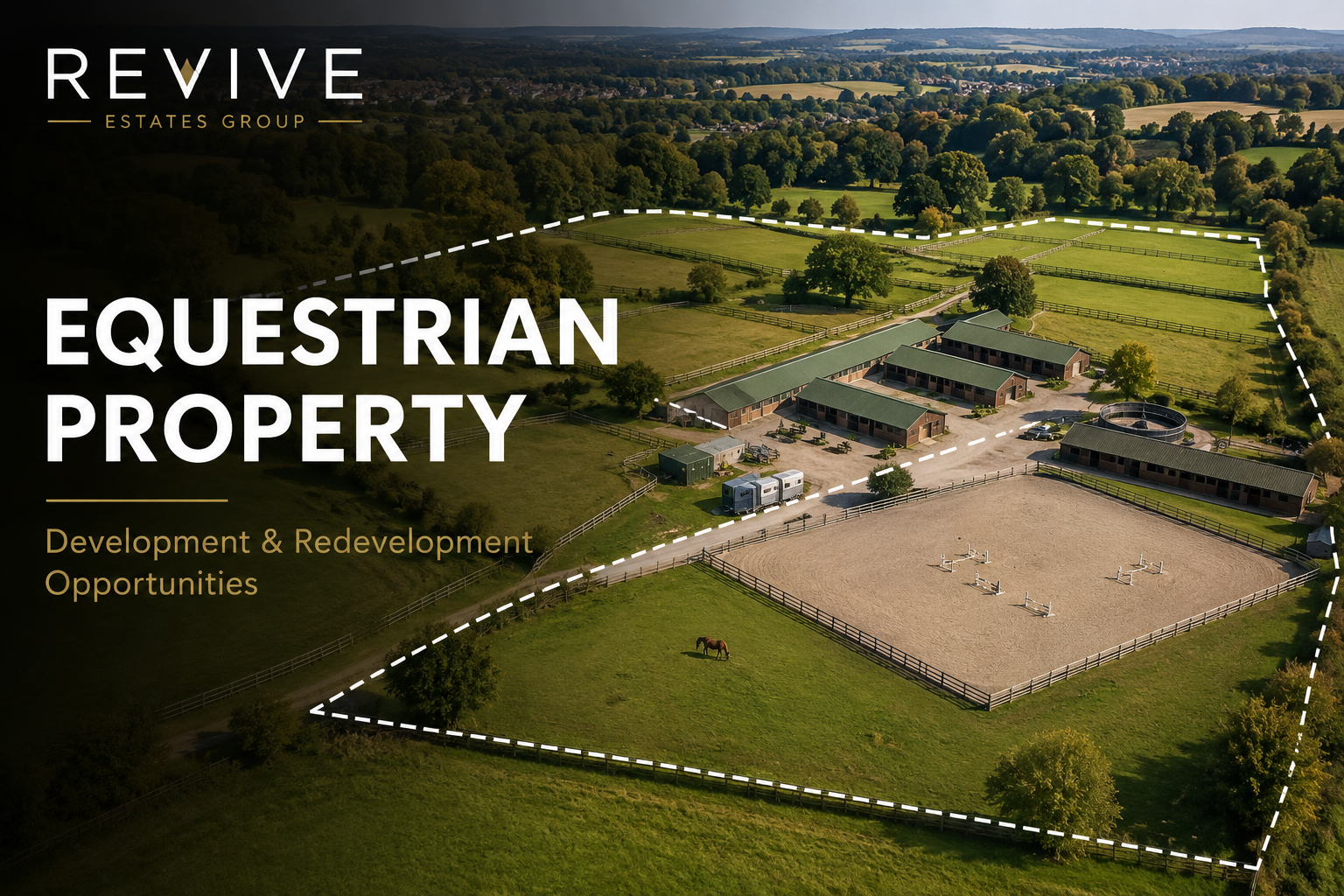
Could Your Equestrian Property Have Development Potential?
Equestrian properties can include substantial paddocks, stables, equestrian buildings and surplus land. In the right circumstances, these elements may create opportunities worth investigating beyond their current use.
FREE LAND ASSESSMENT →What Types Of Equestrian Property Are We Looking For?
Every equestrian property is different. We are interested in sites where the land, buildings, existing use and location may justify investigating whether there is development potential.
Properties With Substantial Paddocks
Larger areas of paddock or grazing land may provide an opportunity worth investigating, particularly where the property sits in a suitable location.
Stable Blocks & Equestrian Buildings
Existing buildings may form an important part of the assessment, including their condition, lawful use, position and relationship with the wider site.
Surplus Or Underused Land
Land that is no longer required for the current equestrian use may be worth reviewing to establish whether another use or development opportunity could exist.
Equestrian Properties With Good Access
The ability to access and potentially serve a development is an important practical consideration, particularly where new access arrangements may be required.
Sites Close To Existing Settlements
The relationship between the property and nearby built development can be an important part of understanding its planning context.
Larger Equestrian Holdings
Properties with significant land holdings may present a range of possibilities, although the planning position and site characteristics need to be considered carefully.
We do not assume that an equestrian property is automatically suitable for development. The existing use, planning position, location and characteristics of each site need to be considered individually.
What Could Be Possible?
The potential opportunity will depend on the existing property, its lawful use, buildings, land, location and planning circumstances. Different sites may therefore require very different approaches.
Residential Development
In suitable circumstances, part of an equestrian property or associated land may present an opportunity for residential development. The planning position and relationship with surrounding development would need careful consideration.
Conversion Or Redevelopment
Existing equestrian or ancillary buildings may warrant investigation for alternative uses or redevelopment, depending on their construction, lawful use, location and the relevant planning requirements.
Subdivision Of Land
Where a property contains surplus land, paddocks or areas no longer required for the existing use, it may be appropriate to consider whether part of the holding could be separated and assessed independently.
Small-Scale Development
Some sites may have potential for a smaller development opportunity rather than a larger scheme. The appropriate scale will depend on access, site layout, surrounding development and planning policy.
Alternative Land Uses
In some cases, the opportunity may not be residential development at all. The existing buildings, location and characteristics of the land may make another use worth investigating.
Potential does not mean planning permission. Any development proposal would need to be considered on its own merits, taking account of the existing use, planning policy, site constraints and the proposed use.
What Determines Whether It Can Work?
Equestrian properties can have a more complex planning starting point than a conventional residential site. The existing use, buildings and surrounding land all need to be understood before considering what may be possible.
An initial assessment looks at the overall planning context rather than simply the amount of land available.
Existing & Lawful Use
Understanding how the property and its buildings are currently used, and the relevant planning history, can be important when assessing future opportunities.
Planning Policy
Local planning policies and the wider development plan will influence what forms of development may be acceptable in the particular location.
Location & Settlement Pattern
The relationship between the property, nearby settlements and existing built development can be an important part of understanding the site's planning context.
Access & Highways
Existing access, visibility, road conditions and the ability to safely serve any potential development can all affect what may be achievable.
Landscape & Countryside Considerations
The site's landscape character, openness and relationship with the surrounding countryside may need to be considered, particularly where development sits outside an established settlement.
Buildings & Site Constraints
The condition and position of existing buildings, together with trees, ecology, drainage, flooding and other physical constraints, can influence the development strategy.
Every equestrian property is different. The presence of paddocks, stables or other buildings does not by itself establish a right to residential development. The opportunity needs to be assessed against the individual site's planning position and characteristics.
Why The Existing Use Matters
An equestrian property is more than simply a piece of land. It may include stables, paddocks, arenas, access arrangements, ancillary buildings and established uses that all form part of the planning picture.
Before considering what might be possible in the future, it is important to understand the property's existing position, including how the land and buildings are currently used and any relevant planning history.
This helps establish which opportunities may be worth investigating and which routes are unlikely to be appropriate.
An Initial Review May Consider
- Current use of the land and buildings
- Existing stables and equestrian facilities
- Paddocks, grazing areas and surplus land
- Planning history and existing permissions
- Access and relationship with surrounding roads
- Relationship with nearby development
The starting point matters. Understanding what already exists allows the development opportunity to be considered realistically rather than simply assuming that unused land or equestrian buildings can automatically be converted or developed.
Which Route Is Right For Your Property?
If an opportunity is identified, the best way forward will depend on the planning prospects, the property itself and your objectives as the landowner.
Land Promotion
Where appropriate, a land promoter may fund and manage the planning process at their own risk, with the landowner sharing the upside if planning is achieved and the property is subsequently sold.
Option Agreement
A developer may agree an option with the landowner, providing a route to pursue planning and development while establishing the purchase terms in advance.
Developer Introduction
Where the property is not suited to Revive promoting or taking an option on directly, we may be able to introduce the opportunity to a suitable developer.
Planning Consultancy
If you are comfortable funding the planning application yourself and taking the planning risk, consultancy support may allow you to retain the resulting sale proceeds, subject to the costs and outcome of the planning process.
Land Sale & Disposal
Where planning has already been obtained, or where an unconditional sale is more appropriate, the focus may be on identifying the right buyer and maximising the disposal opportunity.
Understand The Potential Of Your Property
If you own an equestrian property with paddocks, stables, buildings or surplus land, our team can provide an initial assessment of the site's potential.
We'll consider the characteristics of the property and help you understand whether there may be an opportunity worth exploring further.
REQUEST YOUR FREE LAND ASSESSMENT →Frequently Asked Questions
Answers to some of the questions landowners commonly ask when considering the development potential of an equestrian property.
Potentially. Equestrian properties can contain paddocks, buildings, stables and surplus land that may be worth investigating. However, development potential depends on the individual property's planning position, location, existing use, access and site characteristics.
It depends on the building, its lawful use, location, planning history and the planning route that may apply. A stable or equestrian building cannot automatically be assumed to have a residential conversion opportunity.
No. The amount of paddock land alone does not establish a right to development. Planning policy, location, access, surrounding development and site-specific constraints all need to be considered.
Yes. Understanding the existing use of the land and buildings, together with relevant planning history, can be important when establishing the starting planning position and considering future options.
They can be, although countryside locations can involve additional planning and landscape considerations. The property's relationship with settlements, existing development and the wider planning policy context will be important.
Depending on the circumstances, options may include land promotion, an option agreement, a developer introduction, planning consultancy or sale and disposal. The most appropriate route depends on the property and the landowner's objectives.
Yes. Revive Estates Group offers a free initial land assessment with no obligation to proceed. The assessment is intended to help establish whether the property may present an opportunity worth investigating further.