
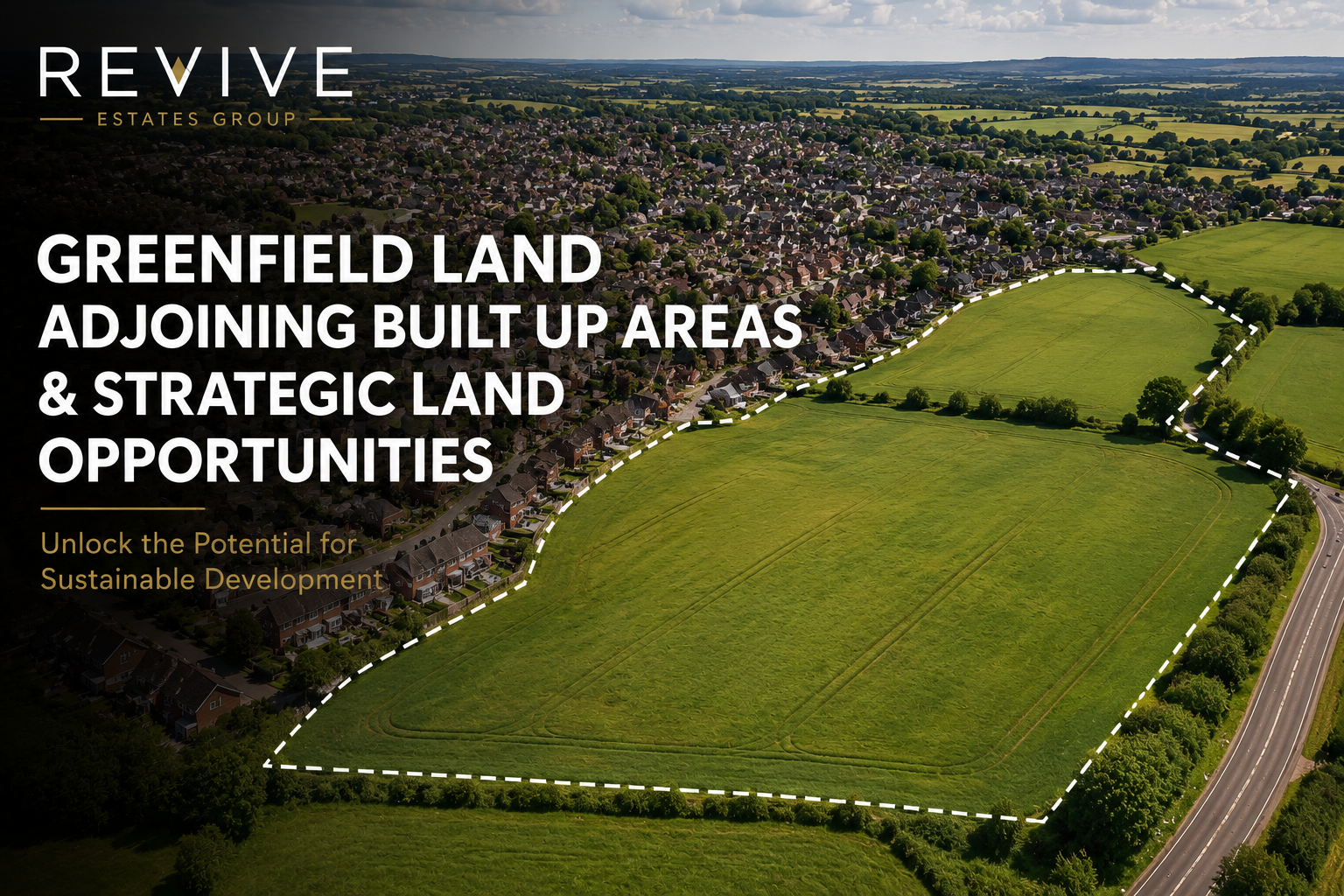
Could Your Land Have Strategic Development Potential?
Land adjoining an existing settlement can sometimes present significant longer-term development opportunities. Strategic land is often land where development may not be immediately achievable, but where its location and surrounding growth could make it worth investigating.
At Revive Estates Group, we help landowners understand whether their land could have strategic potential, what planning factors may influence that potential and which routes could be available to move the opportunity forward.
REQUEST YOUR FREE LAND ASSESSMENT →What Types Of Land Are We Looking For?
Strategic land opportunities can take many forms, but location is particularly important. We are interested in land where its position, surrounding development and wider growth patterns could support longer-term development potential.
Land Adjoining Existing Settlements
Greenfield land located immediately next to an existing town, village or built-up area can sometimes offer strategic potential where future growth could support further development.
Settlement Edge Sites
Land positioned on the edge of an established settlement may be worth investigating where its location provides a logical opportunity for future expansion.
Larger Development Parcels
Larger parcels can sometimes provide greater flexibility for a comprehensive development strategy, particularly where infrastructure and access can be planned as part of a wider scheme.
Land Near Infrastructure
Sites close to existing roads, public transport, utilities, schools, employment areas and other infrastructure may warrant consideration as part of a longer-term development strategy.
Land Near Growing Communities
Areas experiencing population growth, housing demand or planned infrastructure investment may create longer-term opportunities for strategically positioned land.
Land With Multiple Access Options
Land with existing or potentially achievable access to suitable roads can provide greater flexibility when considering how a future development scheme might work.
Strategic land is about the long-term opportunity.
A site does not necessarily need to have an immediate planning opportunity to be worth investigating. Its relationship with an existing settlement, local growth, infrastructure, planning policy and surrounding land can all influence its longer-term potential.
Why Can Strategic Land Be Attractive?
Strategic land can offer a different type of development opportunity from land with immediate planning potential. Its attraction often comes from its position and its longer-term relationship with settlement growth.
Settlement Expansion
Land adjoining an existing settlement may have potential to form part of future expansion where local housing or employment needs require additional development land.
Long-Term Planning Opportunity
A site that is not currently allocated for development may still be worth considering where wider planning policy, growth patterns or infrastructure investment could change its prospects over time.
Larger Development Potential
Strategic sites can sometimes accommodate larger, coordinated schemes where roads, drainage, open space and other infrastructure can be considered as part of an overall development strategy.
Developer Demand
Developers may seek strategic land in locations where they believe there is potential for future housing, employment or mixed-use development.
Infrastructure Growth
New or improved roads, transport links, schools, employment areas and other infrastructure can influence the longer-term development prospects of surrounding land.
Potential Value Uplift
If land progresses through the planning process or becomes allocated for development, its value can be substantially different from its existing agricultural or undeveloped use.
Strategic land is a long-term proposition. There is no guarantee that land will receive planning permission or be allocated for development. The opportunity depends on planning policy, local need, infrastructure, site constraints and many other factors.
What Makes Land Strategically Well Positioned?
The strongest strategic land opportunities are rarely determined by size alone. Location, connectivity, surrounding development and the relationship with an existing settlement can all influence how a site may perform over the longer term.
Relationship With A Settlement
Land adjoining or close to an established settlement may have greater strategic relevance where future growth could logically extend into the site.
Access To Main Roads
Existing or potentially achievable access to suitable roads can be an important consideration when assessing whether a larger development could be accommodated.
Nearby Infrastructure
The availability of utilities, schools, transport, employment and other infrastructure can influence the practicality and attractiveness of future development.
Local Housing Need
Areas experiencing housing demand or identified growth requirements may provide a stronger context for investigating strategically located land.
Planning Policy
Local and national planning policy, settlement boundaries, development allocations and emerging planning strategies can all affect a site's prospects.
Surrounding Land
The way neighbouring land is used and whether nearby sites are already being considered for development can influence the wider strategic context.
Physical Site Constraints
Flood risk, landscape, ecology, topography, heritage and other constraints need to be understood when considering the realistic development potential of land.
Location can matter more than size.
A strategically positioned parcel can sometimes warrant investigation even if it is relatively modest in size. Conversely, a large parcel in an unsuitable location may have limited development prospects. The wider planning context is therefore essential.
What Could Your Strategic Land Be Worth?
Strategic land can have a very different value from land being used solely for agriculture or other existing purposes. Its potential value may reflect the possibility of future development rather than its current use.
There is no standard value for strategic land. Its worth can change significantly depending on planning prospects, location, development capacity, infrastructure and the likelihood of future demand.
Understanding the strategic position of your land can therefore be important before deciding whether to sell, retain, promote or pursue a planning strategy.
Factors That Can Influence Value
Location
The relationship between the land and nearby settlements, transport links, employment and services can strongly influence its strategic importance.
Planning Prospects
Local planning policy, housing requirements, settlement boundaries and future planning strategies can all affect potential value.
Development Capacity
The size, shape, access and characteristics of the site can influence the scale and type of development that could potentially be achieved.
Infrastructure
Roads, utilities, drainage, public transport and other infrastructure can influence whether future development is practical.
Site Constraints
Flood risk, ecology, landscape, topography, heritage and other constraints can affect the amount of land that may realistically be developable.
Developer Demand
Demand from housebuilders and developers for land in the relevant area can influence the attractiveness of a strategic opportunity.
Strategic land value is based on future potential, not simply current use. A site's value can change considerably if its planning position improves, but development prospects are never guaranteed and need to be assessed carefully.
What Can You Do With Strategic Land?
Strategic land often requires a longer-term approach. Depending on the site's position and planning prospects, there are several possible routes a landowner can consider.
Retain The Land
Where future growth is uncertain, a landowner may choose to retain the site while monitoring changes in local planning policy, infrastructure and development patterns.
Promote The Site
Suitable land may be promoted through the planning process with the aim of establishing its credentials for future development.
Work With A Developer
A developer may be interested in securing a strategic land opportunity and working towards its longer-term planning and development potential.
Planning-Led Strategy
In some circumstances, further planning investigation may help establish whether the site has a credible route towards allocation or planning permission.
Strategic Sale
Where there is identifiable developer demand, the land may be marketed to parties looking specifically for longer-term development opportunities.
Could Your Land Have Strategic Potential?
If you own land adjoining an existing settlement or in an area experiencing growth, Revive Estates Group can provide an initial assessment of its potential.
We can consider the site's location, relationship with surrounding development, access and wider development context to help establish whether further investigation could be worthwhile.
REQUEST YOUR FREE LAND ASSESSMENT →Frequently Asked Questions
Some of the most common questions landowners ask when considering whether their land could have longer-term strategic development potential.
Strategic land generally refers to land where development may not be immediately available but where its location, planning context or relationship with a settlement could provide longer-term development potential.
Land adjoining or close to an existing settlement can be particularly relevant, because future growth may create opportunities for settlement expansion. However, every site needs to be assessed in its wider planning context.
Potentially. Agricultural land can sometimes have longer-term development potential depending on its location, relationship with nearby settlements, planning policy, infrastructure and other site considerations.
Not necessarily. Strategic land is often considered because of its potential for future development rather than because planning permission has already been granted. The planning position must be assessed for each individual site.
Strategic land is typically a longer-term opportunity. Its potential may depend on future planning changes, settlement growth, infrastructure or allocation, whereas development land may already have a clearer and more immediate planning route.
There is no fixed value. Location, planning prospects, site size, access, infrastructure, constraints and potential developer demand can all influence the value of strategic land.
Potentially. Developers may seek strategically positioned land where they believe there is a credible longer-term development opportunity. The appropriate sale strategy will depend on the site's circumstances and planning prospects.
Yes. Revive Estates Group offers a free initial land assessment to help establish whether your land may have development potential and whether further investigation could be worthwhile.