
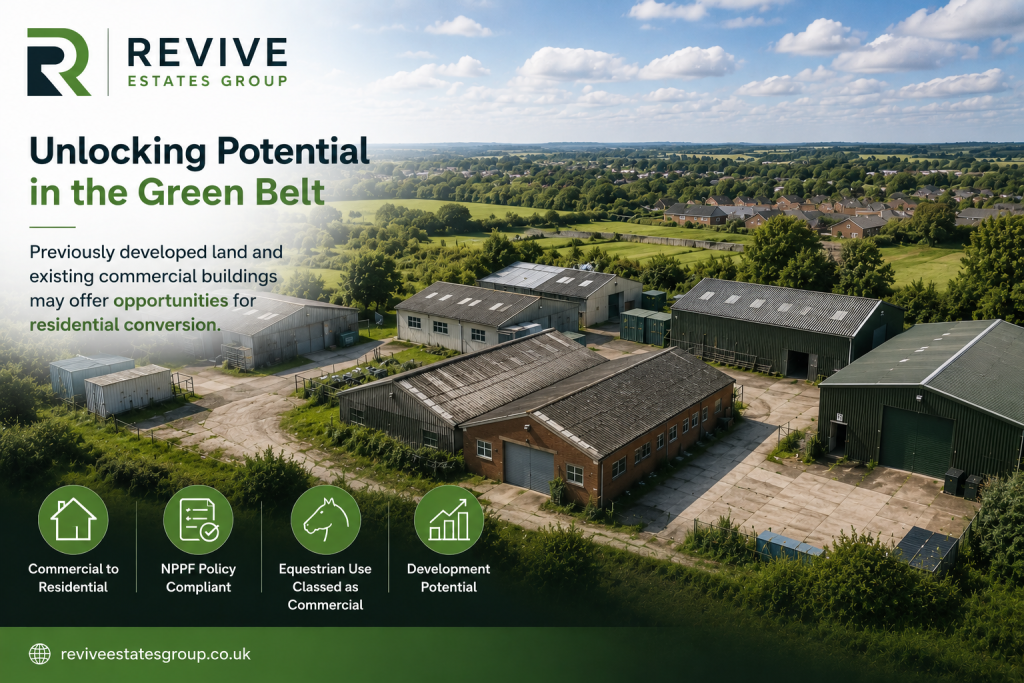
Previously Developed Land in the Green Belt
Green Belt land is often misunderstood. Many landowners assume that once land falls within the Green Belt, development opportunities are extremely limited or impossible. In reality, national planning policy can provide significant opportunities for certain types of previously developed land and existing commercial buildings — particularly where residential conversion or redevelopment proposals can demonstrate compliance with the National Planning Policy Framework (NPPF).
At Revive Estates Group, we regularly assess sites where existing buildings, commercial operations, and equestrian uses may present hidden planning potential, even within designated Green Belt locations.
The short answer
Green Belt does not automatically mean no development. Previously developed land, existing commercial buildings and equestrian uses within the Green Belt can all carry meaningful planning potential — especially following the 2024 NPPF update introducing Grey Belt. If you own developed land or buildings in the Green Belt, a free assessment could reveal opportunities you didn’t know existed.
What Is Previously Developed Land?
Previously Developed Land (PDL), often referred to as “brownfield land”, is land that has been occupied by a permanent structure and associated infrastructure.
Examples can include:
- Commercial yards
- Industrial buildings
- Storage depots
- Workshops
- Redundant business premises
- Former transport uses
- Existing hardstanding and developed compounds
Importantly, national planning policy generally treats the redevelopment of previously developed land in the Green Belt more favourably than undeveloped open countryside.
NPPF Policy on Previously Developed Land in the Green Belt
The National Planning Policy Framework (NPPF) recognises that certain forms of development within the Green Belt may not be inappropriate where specific criteria are met.
Under NPPF paragraph 154 (subject to updates and revisions), limited infilling or the redevelopment of previously developed land may be acceptable where:
- The development would not have a greater impact on the openness of the Green Belt than the existing development; or
- The proposal would contribute to meeting an identified affordable housing need in certain circumstances
This is an important area of policy because many established commercial sites, storage yards, equestrian facilities, and redundant buildings within the Green Belt may already represent developed land.
In practice, planning authorities will often assess:
- Existing built footprint
- Visual impact
- Volume and massing
- Site openness
- Existing lawful use
- Whether redevelopment improves the appearance of the site
In some cases, replacing poor-quality or underutilised commercial buildings with sensitively designed residential development can actually improve the character and openness of a Green Belt site.
Commercial Buildings and Residential Conversion Opportunities
One of the most significant opportunities in recent years has been the conversion of existing commercial buildings into residential dwellings.
Many landowners are unaware that commercial buildings may benefit from:
- Permitted Development Rights
- Prior Approval applications
- Full planning applications for residential conversion
- Redevelopment opportunities on previously developed sites
Government policy has increasingly supported the reuse of existing buildings to help deliver housing while reducing pressure on undeveloped countryside.
Examples of buildings that may offer potential include:
- Former offices
- Storage units
- Workshops
- Light industrial buildings
- Rural commercial premises
- Redundant business operations
Where buildings are structurally suitable and sustainably located, conversion to residential use can sometimes create substantial uplift in land value.
Own commercial buildings or a developed site within the Green Belt?
The presence of existing buildings and established uses can create planning opportunities that aren’t immediately obvious. Our free assessment looks at your site’s planning history, existing use and Green Belt designation to give you an honest view of what may be achievable — at no cost and with no obligation.
Get a Free Green Belt Land Assessment →Understanding the Difference Between Agricultural and Commercial Use
A key issue many rural landowners misunderstand is the distinction between agricultural and commercial planning use.
This distinction can have a major impact on future development opportunities.
Agricultural Use
Agricultural use generally relates to:
- Crop production
- Livestock farming
- Dairy farming
- Horticulture
- Forestry operations
Buildings genuinely used for agriculture may benefit from agricultural permitted development rights, including Class Q barn conversion opportunities in some circumstances.
However, not all rural activity is classed as agriculture.
Why Equestrian Uses Are Often Considered Commercial
Equestrian uses are frequently mistaken for agricultural uses, but in planning terms this is often incorrect.
Many equestrian operations are typically regarded as commercial or leisure uses rather than agriculture.
Examples include:
- Livery yards
- Riding schools
- Horse training facilities
- Indoor riding arenas
- Commercial stabling operations
- Equestrian businesses
This distinction is important because equestrian land and buildings may be treated differently under planning policy and can sometimes provide alternative redevelopment opportunities that would not apply to purely agricultural land.
For example, existing equestrian buildings may already benefit from established commercial planning use, potentially opening routes for:
- Change of use applications
- Redevelopment proposals
- Residential conversion opportunities
- Mixed-use schemes
Each site must be assessed individually, but equestrian operations often present more flexibility than landowners initially realise.
Existing Buildings Can Strengthen Planning Arguments
Within Green Belt policy, the presence of established buildings and developed footprints can be highly significant.
Previously developed sites with existing built form may offer opportunities where proposals:
- Reuse existing structures
- Reduce visual impact
- Improve site appearance
- Replace poor-quality buildings
- Deliver sustainable development benefits
- Avoid encroachment into undeveloped countryside
This is particularly relevant where existing commercial buildings are already impacting openness or visual amenity.
In some situations, carefully designed residential redevelopment can result in a better planning balance than retaining redundant or unattractive commercial uses.
Key Factors That Influence Planning Potential
Every site is different, but important considerations typically include:
- Existing lawful use
- Planning history
- Building condition and structure
- Access and highways
- Sustainability of location
- Green Belt impact
- Nearby residential context
- Environmental constraints
- Local authority policy position
Understanding these factors early can help landowners identify realistic opportunities before making decisions regarding sale, promotion, or development.
Don’t assume your Green Belt land has no development potential.
Many landowners with commercial premises, storage yards, equestrian facilities or redundant rural buildings within the Green Belt are sitting on hidden planning potential. The 2024 NPPF changes have further strengthened the case for previously developed and Grey Belt sites.
Our free land assessment reviews your site’s existing use, planning history and Green Belt designation to give you an honest, independent picture of what opportunities may exist — before you spend a penny on professional fees.
Get My Free Land Assessment →Takes 2 minutes · No cost · No obligation · Reviewed personally by our team
Why Landowners Should Seek Early Advice
Many valuable opportunities are overlooked because owners assume Green Belt designation automatically prevents development.
In reality, existing commercial uses, previously developed land, and equestrian operations can all create planning potential that may not be immediately obvious.
At Revive Estates Group, we help landowners assess sites across the UK to identify whether commercial buildings, equestrian facilities, or previously developed land may offer residential conversion or redevelopment potential.
Green Belt policy is complex — but it is not always prohibitive. If you own previously developed land, commercial buildings, an equestrian facility or a redundant rural site within the Green Belt, the opportunities may be greater than you assume.
At Revive Estates Group, we provide a free, no-obligation assessment for landowners with Green Belt sites across the UK. We’ll review your site’s planning history, existing use, designation and constraints — and give you an honest, expert view of what development potential may exist and what the realistic options are.
Request Your Free Land Assessment →No cost. No obligation. Every enquiry is reviewed personally by our team — we’ll tell you honestly whether your Green Belt land has potential worth exploring.