
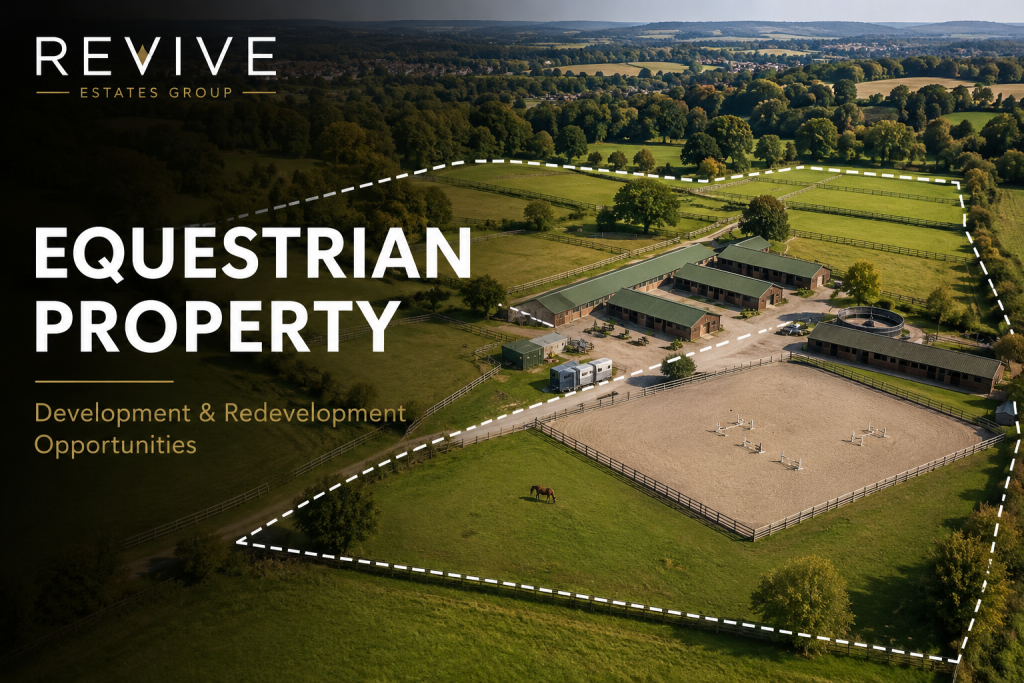
For many owners, equestrian properties are far more than just land and buildings. They are businesses, family homes, and often the result of years of hard work and investment.
However, as operating costs continue to rise and planning policy evolves, an increasing number of riding school owners, livery yard operators, and private stable owners are beginning to ask an important question:
Could my equestrian property have development potential?
The answer is not always straightforward, but in many cases the opportunities are greater than owners realise.
The short answer
Equestrian properties often have more development potential than owners realise. Existing buildings, established uses, semi-rural locations and evolving planning policy — including the 2024 Grey Belt changes — mean many stable yards, livery businesses and riding schools are worth a professional look. A free assessment costs nothing and could reveal significant hidden value.
Why Equestrian Properties Attract Developer Interest
Unlike agricultural land, equestrian sites often contain a significant amount of existing development.
Many include:
- Stable blocks
- Indoor or outdoor riding arenas
- Parking areas
- Access roads
- Storage buildings
- Workshops
- Staff facilities
From a planning perspective, these existing features can make a site very different from an undeveloped field.
Developers are often interested in land that already has infrastructure in place, particularly where a site is located close to existing towns, villages, or residential areas.
This is one reason why equestrian properties frequently attract interest from land promoters, developers, and investors.
Is Equestrian Land the Same as Agricultural Land?
This is one of the most common misunderstandings among rural landowners.
While agriculture and equestrian uses are often found side by side, they are not necessarily the same thing in planning terms.
Agriculture generally relates to activities such as:
- Growing crops
- Livestock farming
- Dairy farming
- Horticulture
By contrast, activities such as:
- Riding schools
- Commercial livery yards
- Horse training facilities
- Riding arenas
- Equestrian centres
are usually considered separate uses.
This distinction can be important because planning policies that apply to agricultural land may not always apply to equestrian property in the same way.
Why Riding Schools Are Increasingly Being Redeveloped
Across the UK, many traditional riding schools are facing challenges.
Rising operating costs, insurance, staffing pressures, and land values have made some businesses increasingly difficult to operate profitably.
At the same time, many riding schools occupy substantial sites in locations where housing demand is strong.
This has led to a growing number of former riding schools being considered for alternative uses.
While every site is different, redevelopment opportunities can sometimes include:
- Residential development
- Mixed-use schemes
- Commercial redevelopment
- Leisure-led development
- Strategic land promotion
The key factor is often location.
A riding school in an isolated rural location may have very different prospects from one situated on the edge of a growing town.
Green Belt Doesn’t Always Mean No Opportunity
One of the biggest myths surrounding development is that Green Belt land can never be developed.
The reality is more complex.
Many equestrian properties are located within the Green Belt because horse-related uses are often considered appropriate in rural areas.
However, Green Belt policy does not automatically rule out all forms of development.
The National Planning Policy Framework recognises circumstances where redevelopment, replacement buildings, and the reuse of previously developed land may be acceptable.
Properties containing existing buildings, hardstanding, and commercial equestrian uses often warrant closer examination than owners initially expect.
The emergence of discussions around Grey Belt land has further increased attention on certain developed sites within the Green Belt.
Own a stable yard, livery or riding school in or near the Green Belt?
Green Belt designation doesn’t automatically rule out development — especially where existing buildings and commercial equestrian uses are already present. Our free assessment looks at your site’s planning history, designation and constraints to give you an honest view of what may be possible.
Get a Free Equestrian Land Assessment →Can Stables Be Converted Into Residential Properties?
This is one of the most searched questions online.
Unfortunately, there is no universal answer.
The potential to convert stables into homes depends on a range of factors, including:
- The construction of the building
- Its lawful planning use
- Planning history
- Local planning policy
- Environmental constraints
- Green Belt designation
Many stable buildings were never designed for residential occupation, which can create challenges.
However, some sites may offer opportunities through conversion, replacement development, or wider redevelopment proposals.
The important point is that assumptions should never be made without obtaining professional advice.
The Rise of Strategic Land Opportunities
Some equestrian properties occupy land immediately adjoining existing settlements.
As councils review housing requirements and prepare Local Plans, land on the edge of towns and villages often comes under scrutiny.
This does not mean development is inevitable.
However, it does mean that some equestrian landowners may be sitting on sites with longer-term strategic potential. See more details on the Strategic Land Page
Land that currently supports horses may one day be considered as part of a wider growth strategy for an area.
Understanding where your property sits within the planning landscape can therefore be extremely valuable.
Thinking about the future of your equestrian property?
Whether you’re exploring options now or planning for the longer term, understanding your site’s planning position costs nothing — and could reveal opportunities that significantly change the value of what you own.
Our free land assessment covers equestrian properties of all types — private stable yards, commercial livery businesses, riding schools and former equestrian centres. We’ll give you an honest, independent view of what your site could realistically achieve.
Get My Free Land Assessment →Takes 2 minutes · No cost · No obligation · Reviewed personally by our team
What Should Equestrian Landowners Do?
The first step is understanding what you own from a planning perspective.
Many landowners know every inch of their property physically but have never investigated:
- Planning history
- Development constraints
- Green Belt considerations
- Local Plan allocations
- Strategic growth areas
- Previously developed land opportunities
Without this information, it is difficult to make informed decisions about the future.
Even if development is not an immediate objective, understanding the potential of your property can help shape long-term business and investment decisions.
Final Thoughts
Not every equestrian property will have development potential.
However, many owners underestimate the significance of existing buildings, established uses, strategic locations, and evolving planning policy.
Whether you own a private stable yard, a commercial livery business, or a former riding school, taking the time to understand your property’s planning position could reveal opportunities that are not immediately obvious.
As housing demand continues to grow and planning policy evolves, equestrian properties are likely to remain firmly on the radar of developers, land promoters, and local authorities alike.
If you own stables, a livery yard, a riding school or an equestrian centre, it’s worth taking the time to understand your site’s planning position. Many equestrian landowners are surprised to find that their property has development potential they had no idea existed — and that finding out costs nothing.
At Revive Estates Group, we provide a free, no-obligation land assessment for equestrian landowners across the UK. We’ll review your site’s planning history, designation, existing use and location — and give you an honest view of what opportunities may exist and what the realistic next steps could be.
Request Your Free Land Assessment →No cost. No obligation. Every enquiry is reviewed personally by our team — we’ll tell you honestly whether your equestrian property has potential worth exploring.