
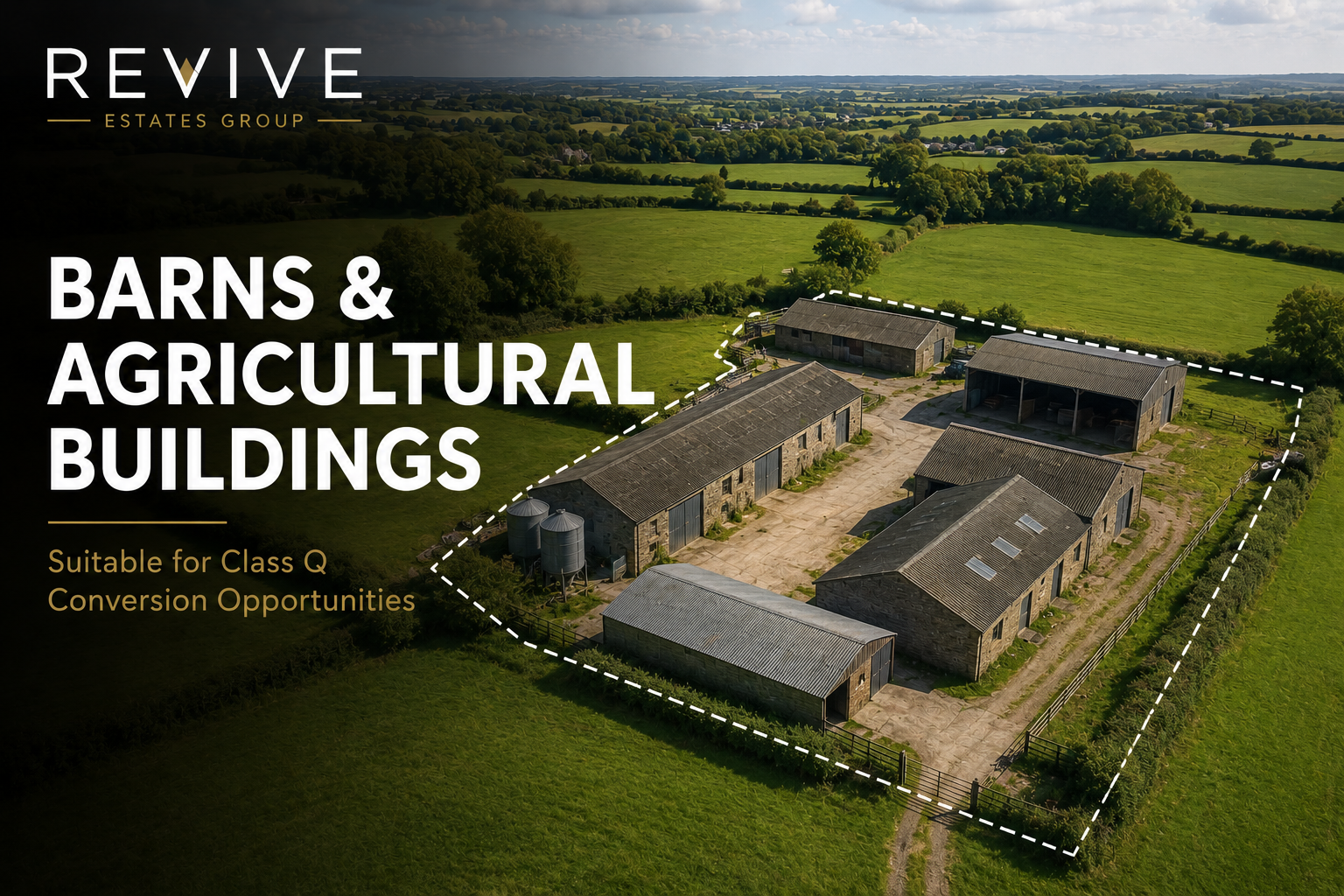
Could Your Agricultural Barn Be Converted Into Homes?
Class Q permitted development rights can allow certain agricultural buildings to be converted to residential use without going through a conventional full planning application.
But Class Q is not automatic. The building, its agricultural history, planning position, physical condition, location and proposed conversion all need to meet the relevant requirements.
GET A FREE CLASS Q ASSESSMENT →What Exactly Is Class Q?
Class Q is a permitted development right within the General Permitted Development Order that can allow certain agricultural buildings to be converted into residential dwellings.
Instead of making a conventional full planning application, qualifying proposals are considered through a prior approval process covering specific planning matters.
However, Class Q is a set of permitted development rights with detailed eligibility requirements. A barn does not qualify simply because it is agricultural or because it is no longer being used.
Agricultural Building
The building must meet the relevant requirements concerning its relationship with an established agricultural unit or qualifying former agricultural use.
Residential Use
Class Q provides a route for qualifying agricultural buildings to be converted to residential dwellings falling within Use Class C3.
Conversion Rather Than Rebuilding
The right is intended for conversion of an existing building. The structure must therefore be capable of conversion without effectively becoming a new-build development.
Prior Approval
Class Q does not mean that you can simply start work. An application for prior approval must be considered by the local planning authority before the development can proceed.
Specific Limits Apply
The current rules include limits relating to the number of dwellings, total floorspace, individual dwelling size, physical works and the agricultural unit.
Class Q is not automatic permitted development. The building, its history, the agricultural unit, the proposed works and the site's planning circumstances all need to be assessed before deciding whether the route is available.
Does Your Barn Meet The Requirements?
Before considering the potential number of homes or the value of a conversion, the first step is establishing whether the building and site can qualify for Class Q.
Agricultural Use & History
The building and agricultural unit need to satisfy the relevant requirements concerning agricultural use and the qualifying period. The history of the building therefore matters.
The Existing Building
Class Q is intended to facilitate the conversion of qualifying agricultural buildings. The physical characteristics and condition of the existing structure are therefore important considerations.
Location
The location of the building must be considered against the restrictions and exclusions that apply to Class Q, including relevant protected or designated areas.
Proposed Conversion
The proposed works must fall within the scope of the permitted development right. The nature and extent of external and internal works therefore need to be carefully considered.
Size & Dwelling Limits
The current Class Q framework places limits on the amount of floorspace and number of homes that can be created, together with restrictions affecting the individual dwellings.
Prior Approval Matters
Even where a proposal appears to qualify, the relevant prior approval process still needs to be followed. Matters such as transport, flooding, noise and other applicable considerations may need to be addressed.
The key point
A barn being agricultural does not automatically make it a Class Q opportunity. The building's history, location, structure, proposed works and the current permitted development rules all need to be assessed together.
How Many Homes Could Be Created?
The 2024 changes significantly increased the potential scale of qualifying Class Q conversions. However, the maximum figures are subject to the detailed requirements of the permitted development right.
These are maximum framework limits, not a guaranteed development outcome. The number and size of dwellings that may actually be achievable will depend on the qualifying agricultural unit, the existing building, the available floorspace, the proposed conversion and the other requirements of Class Q.
A smaller barn may therefore have potential for only one or a few homes, while a larger qualifying agricultural unit may potentially support a greater number of dwellings, subject to the detailed rules.
What Can Stop A Barn From Qualifying?
Class Q can provide an attractive route for qualifying agricultural buildings, but there are a number of reasons why a proposed conversion may not be straightforward. These need to be identified before relying on the permitted development route.
The Agricultural History
The relevant agricultural use and history of the building and agricultural unit need to satisfy the applicable Class Q requirements. Establishing the history of the site is therefore an important first step.
The Building May Not Be Suitable
Class Q relates to the conversion of an existing agricultural building. The extent of structural works and the condition of the building can therefore be critical to whether the proposed scheme falls within the permitted development right.
Location Restrictions
Certain locations and designated areas can be subject to restrictions or exclusions. The precise location of the building therefore needs to be checked against the current Class Q legislation.
External Works
A proposed conversion may involve works to the building's exterior. Those works must remain within the scope permitted by Class Q rather than effectively creating a new building.
Prior Approval Matters
A Class Q proposal still has to go through the relevant prior approval process. Depending on the proposal, matters such as transport, highways, flooding, noise and other prescribed considerations may need to be addressed.
The Proposed Layout
Even where a barn qualifies in principle, the number, size and arrangement of dwellings must remain within the applicable Class Q limits and requirements.
A Class Q assessment should happen before the conversion is designed around assumptions. Establishing the building's planning history, agricultural use, location and physical characteristics first can help determine whether Class Q is genuinely the right route.
What Could Your Barn Conversion Be Worth?
A qualifying Class Q opportunity can potentially be worth considerably more than an agricultural building in its existing use.
However, there is no standard value for a Class Q barn. The potential value depends on what can realistically be achieved and what buyers or developers are prepared to pay for the opportunity.
Understanding the potential before committing to a particular route can help you make a more informed decision about your property.
Factors That Can Influence Value
Number Of Potential Dwellings
The scale of the potential conversion can have a significant bearing on the overall opportunity.
Location
Local housing demand, accessibility and the strength of the surrounding property market can all influence development value.
Building & Conversion Potential
The existing structure, layout and condition can affect the practicality and cost of achieving the proposed conversion.
Planning Position
The strength of the Class Q case and the likelihood of successfully navigating prior approval will affect how the opportunity is viewed by the market.
Development & Sale Costs
Conversion costs, professional fees, infrastructure and other expenses need to be considered when assessing the overall economics.
Development potential is not the same as development value. A proper assessment considers what may be achievable, the risks involved and the likely costs before drawing conclusions about the opportunity.
What Can You Do With A Class Q Opportunity?
If your barn appears to have potential, there are several ways to approach the opportunity. The right route will depend on the planning position, the property and your objectives as the landowner.
Pursue Class Q Yourself
You may choose to instruct the relevant professionals and pursue the Class Q prior approval process yourself, retaining control of the project and taking responsibility for the associated costs and risks.
Land Promotion
Where appropriate, a land promoter may take on the planning process at their own risk, with the aim of securing the best possible planning outcome before marketing the land.
Option Agreement
An option arrangement can provide a route for a developer to take the opportunity forward, subject to agreed terms and the relevant planning process.
Developer Introduction
Depending on the site and circumstances, Revive may be able to introduce the opportunity to a suitable developer interested in Class Q or rural development opportunities.
Sale & Disposal
Where an existing Class Q approval or established opportunity is ready for the market, the focus may instead be on identifying an appropriate buyer and maximising the disposal opportunity.
Find Out If Your Barn Could Have Class Q Potential
If you own an agricultural barn that may be suitable for residential conversion, Revive Estates Group can provide an initial assessment of the opportunity.
We'll look at the key characteristics of the building and site to help establish whether Class Q appears worth investigating further.
REQUEST YOUR FREE CLASS Q ASSESSMENT →Frequently Asked Questions
Some of the most common questions landowners ask when considering whether an agricultural barn could have Class Q conversion potential.
Class Q is a permitted development right that can allow certain agricultural buildings to be converted into residential dwellings, subject to the relevant requirements and prior approval process.
No. The building, agricultural use and history, location, physical characteristics, proposed works and other requirements all need to satisfy the applicable Class Q rules.
Under the current framework, up to 10 dwellings may potentially be created within the applicable limits, including the relevant floorspace restrictions. The maximum is not automatically available to every building.
Class Q is a permitted development route, but qualifying proposals generally still require the relevant prior approval process before development can proceed. It should not be treated as an automatic right to convert a barn.
Potentially, depending on the circumstances and the applicable Class Q requirements. The previous agricultural use and relevant qualifying history need to be established rather than assumed.
The position depends on the specific location and the requirements and restrictions applicable to Class Q. A Green Belt location should therefore be assessed carefully rather than assumed to qualify or fail automatically.
Values vary significantly. Location, the number of potential dwellings, conversion costs, planning prospects, market demand and the characteristics of the existing building can all affect the value of the opportunity.
Yes. Revive Estates Group offers a free initial land assessment to help establish whether your agricultural building or wider property may have development potential.