
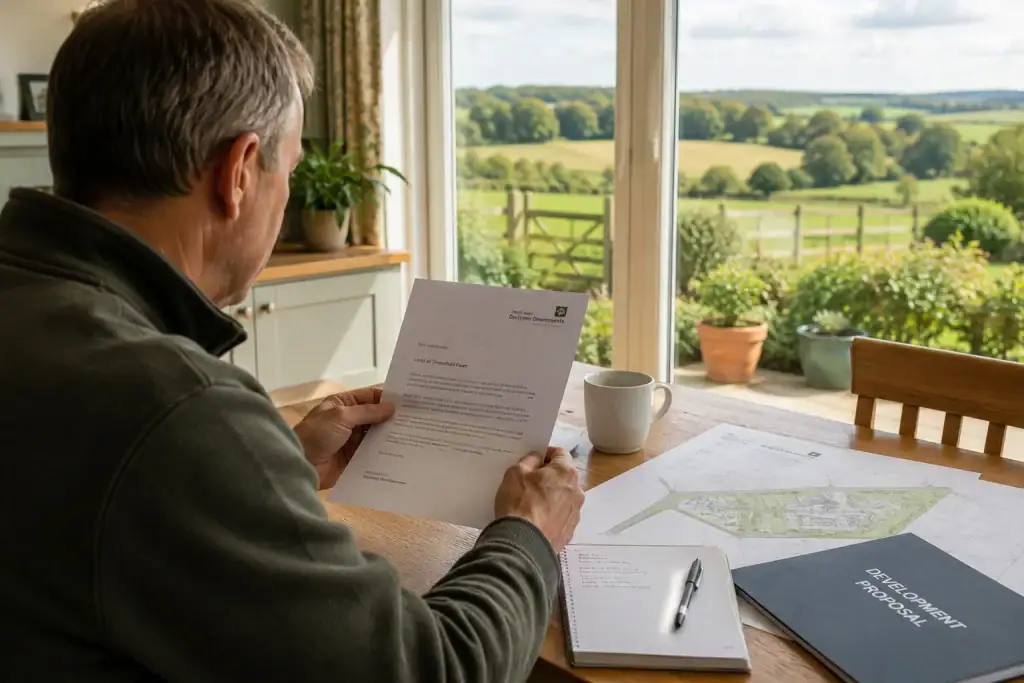
It happens more often than you might think. A letter arrives in the post, an email lands in your inbox, or someone knocks on your door. A developer or land promoter is interested in your land and wants to talk.
For many landowners, this moment comes completely out of the blue. You may never have considered that your land had development potential, or you may have had a vague sense that it might be worth something but never pursued it. Either way, being approached by a developer can feel both exciting and overwhelming — and it raises a lot of important questions.
What do they actually want? Is their offer fair? Should you sign anything? Do you need a solicitor? Are there better options available?
This guide explains exactly what happens when a developer approaches you, what to watch out for, and how to make sure you get the best possible outcome for your land.
The short answer
Don’t sign anything yet. When a developer approaches you, it’s because they’ve identified your land as a commercial opportunity — for them. The first offer is rarely the best available, and signing before you understand your options could cost you significantly. Getting independent advice first is free, takes minutes, and could make a substantial difference to the outcome.
Why Has a Developer Approached You?
The first thing to understand is that developers and land promoters are professionals whose business depends on identifying land with development potential — often before the landowner is aware of it themselves.
They use planning information, mapping tools, property records and local market knowledge to identify sites that could potentially be developed. If a developer has approached you, they may believe your land has development potential and want to secure an opportunity to acquire or control it before other buyers become interested.
This does not necessarily mean that the developer is trying to take advantage of you. Their approach may represent a genuine opportunity. However, it is important to remember that they are making a commercial decision based on what they believe the land could be worth to them.
The fact that a developer wants to buy your land is therefore worth taking seriously — but it should also prompt you to ask an important question: have they identified something about your land that you haven’t yet fully explored?
What Are They Likely to Be Proposing?
When a developer or land promoter contacts you, they will typically be proposing one of the following:
An Option Agreement
An option agreement gives the developer the right — but not the obligation — to purchase your land at an agreed price or formula, usually within a set timeframe and subject to planning permission being granted.
During the option period, the developer will typically fund and manage the planning process. If planning permission is secured and they choose to exercise the option, the sale completes at the agreed terms. If they decide not to proceed — for example because planning permission was refused or the scheme is no longer viable — they can simply let the option lapse and walk away.
The important point with an option agreement is that the terms can have a significant impact on the landowner. The price formula, option period, planning control, extension rights and the circumstances in which the developer can exercise or allow the option to lapse all need careful consideration. The agreed price may also not reflect the full value of your land if planning permission is subsequently secured.
A Promotion Agreement
A promotion agreement works differently. Rather than agreeing to sell to the developer directly, you appoint a land promoter to seek planning permission on your behalf. Once planning permission is granted, the land is sold on the open market — typically at auction or by informal tender — and the promoter takes an agreed percentage of the sale proceeds as their fee. The key advantage for the landowner is that, where planning permission is secured, the land can be marketed to potential buyers rather than being tied to a sale to the promoter at a price agreed before planning. This can provide an opportunity to test the open market and potentially achieve a stronger sale price. The promoter will usually fund the agreed planning and promotion costs, although the precise arrangements should always be checked in the agreement.
A Conditional Contract
A conditional contract is an agreement to sell your land to a specific developer, subject to planning permission being granted. Unlike an option agreement, both parties are committed to the transaction if the condition is met — the developer cannot simply walk away if planning is secured.
Conditional contracts can offer more certainty for the landowner but less flexibility. The agreed price is typically fixed or formula-based, which means you may not fully benefit from any increase in land value during the planning process.
An Unconditional Offer
Occasionally, a developer will make an unconditional offer to purchase your land outright, without any planning condition. This offers immediate certainty and cash in hand, but the price will reflect the risk the developer is taking on — meaning it will typically be significantly lower than the value of the land with planning permission.
Unconditional offers can sometimes be the right choice — particularly where a landowner needs certainty or liquidity. However, the offer should be considered against the potential value of the land with planning permission, the costs and risks involved in pursuing that potential, and the alternatives available to you.
What Should You Do When First Approached?
Being approached by a developer can be a valuable opportunity, but you should not feel pressured to accept the first proposal or agree to terms before understanding what your land may be worth and what alternatives are available.
1. Don’t Sign Anything Immediately
This is the single most important piece of advice. No matter how attractive the offer sounds or how much pressure you feel, do not sign an agreement without taking independent professional advice first.
Option agreements, promotion agreements and conditional contracts are legally binding arrangements that can affect your land for several years. The terms can be complex and the implications significant, so make sure you understand exactly what you are agreeing to before committing.
2. Don’t Assume the First Offer Is the Best One
A developer who approaches you has already identified a potential commercial opportunity. That does not mean their offer represents the maximum value your land could achieve.
Before accepting an offer, it is worth understanding whether other developers might be interested in the site and whether alternative routes could produce a better outcome. Depending on the circumstances, introducing the site to other potential developers or putting the land on the open market can create competition and give you a clearer picture of what buyers are prepared to pay.
3. Find Out What Your Land Is Actually Worth
The value of development land can vary substantially depending on its planning potential, location, proposed use, access, constraints and the route taken to secure planning permission.
Before negotiating with a developer, you should understand the realistic value of your land both in its current state and, where appropriate, what it could be worth with planning permission. This gives you a much stronger position when considering an offer or negotiating the terms of a proposed agreement.
A free land assessment from Revive Estates Group can provide an initial professional view of your land’s potential and the options available to you, without any obligation to proceed.
4. Negotiate the Offer and the Terms
Yes, you can negotiate with a developer. The initial price is not necessarily the final price, and there may be other terms within the proposed agreement that are equally important.
Depending on the circumstances, negotiations may cover the purchase price, price calculation, deposit or option payment, length of the agreement, extension periods, planning control, overage provisions, legal costs and the circumstances in which the agreement can be terminated.
Having an independent understanding of your land’s potential before negotiations begin can put you in a much stronger position. It also helps you assess whether the developer’s proposal represents a fair deal or whether another route may produce a better result.
5. Get Independent Legal Advice
Any agreement you sign should be reviewed by a solicitor with experience in development land transactions. The legal and financial implications of option agreements, promotion agreements and conditional contracts can be significant, and a solicitor can identify terms that may be unfavourable and negotiate improvements on your behalf.
Many developers and promoters will contribute towards legal costs as part of an agreement, although this should always be confirmed and considered as part of the overall terms.
How was the offer price arrived at?
6.How was the offer price arrived at?
Ask the developer to explain how they have calculated their offer and what assumptions they have made about the site’s development potential. A headline figure can look attractive, but the important question is whether it reflects what the land could realistically be worth and whether the proposed terms allow you to benefit from any future increase in value.
7. Take Your Time
You are under no obligation to respond immediately. A genuine developer or promoter should understand that you need time to take advice and consider your options.
Taking time to understand the value of your land, compare the proposal with the alternatives and obtain independent legal advice can help you make a decision based on the best available information rather than pressure from the person making the offer.
Key Questions to Ask Before Signing Anything
Before entering into any agreement with a developer or promoter, make sure you can answer the following questions:
What is the proposed price or price formula — and is it fair? How is the price calculated? Is it a fixed sum, a percentage of open market value, or based on a residual land value calculation? Understanding how the price is determined — and whether it reflects the true potential of your land — is critical.
How long does the agreement last? Option agreements and promotion agreements typically run for between 3 and 10 years. During this period, your land is tied to the agreement and you cannot sell or develop it independently. Understand what happens at the end of the term if planning has not been secured.
Who controls the planning process? In an option agreement, the developer typically controls all planning decisions — what is applied for, when, and how. This may not align with your interests as a landowner. In a promotion agreement, the promoter acts on your behalf, but you should still understand the extent of your involvement and approval rights.
What costs are you responsible for? In most cases, a developer or promoter will fund all planning costs. However, you may still be liable for legal fees, overage arrangements or other costs depending on the specific terms. Make sure you fully understand your financial exposure.
What happens if planning permission is refused? Understand clearly what happens if the planning process is unsuccessful. Can the developer walk away? Are there any payments to you in this scenario? What are your options if the agreement lapses?
Is there an overage or clawback clause? Some agreements include overage provisions that entitle the developer to a share of any future increase in value if the land is subsequently developed for a higher density or more valuable use. These can significantly reduce your long-term return and should be scrutinised carefully.
What Are the Alternatives to Accepting the Developer’s Proposal?
What Are the Alternatives to Accepting the Developer’s Proposal?
Being approached by a developer does not mean you have to accept their terms — or even deal with that particular developer. Depending on your circumstances, there may be several alternative routes worth considering.
Seek competing offers — if one developer has identified your land as having potential, other developers may also be interested. Introducing the site to other potential buyers can create competition and give you a better understanding of what the market may be prepared to pay.
Have the approach independently assessed — before accepting an offer, it can be valuable to have an independent assessment of your site’s planning potential, likely value and the terms being proposed. This can help you establish whether the offer represents a fair deal and whether there are better alternatives.
Appoint a land promoter — rather than selling directly to the developer who approached you, you may be able to appoint an independent land promoter to pursue planning permission and subsequently market the land to potential buyers. This can be particularly relevant where obtaining planning permission could significantly increase the value of the site.
Pursue planning permission yourself — depending on the nature of your site, it may be possible to pursue a planning application independently before selling. This involves costs, risk and professional fees, but in some circumstances securing planning permission can substantially increase the value of the land.
Continue with the developer who approached you — there is nothing wrong with accepting an approach if, after taking independent advice, the terms represent an attractive and appropriate outcome for you. The important point is that you should make that decision from an informed position rather than simply accepting the first proposal.
Do nothing for now — if the timing isn’t right or you are not ready to commit, it is perfectly reasonable to decline or defer the approach. You do not have to sell your land simply because a developer has expressed an interest.
Ask Revive Estates Group to assess your options — if a developer has approached you about your land, our free land assessment can provide an initial professional view of the site’s development potential, likely options and the approach you have received. Depending on the site’s potential and your objectives, we may also be able to introduce the opportunity to other potential developers or discuss promoting the land ourselves.
Get your free land assessment →
Red Flags to Watch Out For
Not every approach from a developer is a problem, and many approaches will be genuine commercial opportunities. However, there are some warning signs that should make you pause and seek independent advice before agreeing to anything.
Pressure to sign quickly — be cautious if you are being told that the offer is only available for a short period or that you must sign immediately. You should have sufficient time to understand the proposal and obtain professional advice.
A proposal that is difficult to understand — if the agreement contains complex terms that you do not fully understand, do not rely solely on the developer to explain them. Ask an independent solicitor to review the agreement before you sign.
A price that is presented without explanation — a headline figure does not necessarily tell you what your land is worth. Ask how the developer has arrived at the figure and what assumptions have been made about planning, development potential and costs.
Long option periods or extensive extension rights — a long period during which the developer controls the opportunity can affect your ability to deal with the land elsewhere. Make sure you understand the length of the agreement, any extension rights and what happens if the developer does not proceed.
Restrictions on dealing with other buyers — understand whether the proposed agreement prevents you from speaking to or negotiating with other potential buyers. Exclusivity and other restrictions should be considered carefully before you commit.
Unclear responsibility for costs — establish who will pay legal, planning and other professional costs, and whether any costs could become your responsibility if the transaction or planning process does not proceed.
The presence of one of these points does not necessarily mean that a developer’s proposal is unfair. The important thing is to understand exactly what you are being offered and how it compares with the alternatives available to you.
A developer has approached you — but is their offer right for you?
Before you accept an offer or sign an agreement, it is worth understanding your land’s development potential and what alternatives may be available. Our free land assessment provides an initial professional view of your site’s potential and your options.
Get My Free Land Assessment →Takes 2 minutes · No cost · No obligation · Reviewed personally by our team
Real Landowners Are Often Surprised by What Their Land Is Worth
Landowners can sometimes have very different expectations of what their land is worth compared with a developer’s assessment. This is particularly true where the land has potential for residential or other forms of development that the owner may not have previously considered.
The value of development land is not simply based on its existing use. Factors such as planning potential, location, access, site constraints, surrounding development and the likely end use can all have a significant influence on value.
This is why it is important to understand the potential of your land before agreeing to a sale or entering into a long-term agreement with a developer. An initial assessment can help you understand whether the proposal you have received appears reasonable and whether there may be other options worth exploring.
If a developer has approached you about your land, you can request a free land assessment from Revive Estates Group to get an initial view of your site’s potential and the options that may be available.
Frequently Asked Questions
What should I do if a developer wants to buy my land?
Don’t feel pressured to accept the first offer. Before agreeing to sell, find out what your land may be worth, understand the development potential and consider whether other developers or alternative routes could produce a better outcome. You should also take independent legal advice before signing any agreement.
Can I negotiate the price of my land with a developer?
Yes. A developer’s initial offer is normally open to negotiation, although the scope for negotiation will depend on the site’s potential, the developer’s appraisal and the terms being proposed. Negotiation can cover not only the purchase price but also deposits, overage, option periods, extension rights and other contractual terms.
How do I know if a developer’s offer is fair?
The best way to assess an offer is to understand the realistic development potential and value of your land and compare the proposal with alternative options. An independent assessment can help you understand whether the offer appears reasonable and whether there may be other ways to maximise the value of the site.
Can I approach other developers if one developer has already made me an offer?
In many circumstances, yes, although you should check whether you have already agreed to any exclusivity or other restrictions. If you have not committed to the developer, introducing the site to other potential buyers can create competition and help establish what the market may be prepared to pay.
Should I use a solicitor when selling land to a developer?
Yes. Development land agreements can contain complex legal and financial terms. You should use a solicitor with relevant experience in development land transactions to review any proposed agreement and advise you before signing.
What if I have already signed an agreement with a developer?
If you have already signed an agreement, the position will depend on the specific terms and circumstances. Do not assume that you can simply withdraw or renegotiate. If you have concerns about an agreement you have signed, speak to a solicitor experienced in development land as soon as possible.
Can Revive Estates Group help if a developer has approached me?
Yes. We can provide an initial assessment of your land and help you understand its development potential and the options that may be available. Depending on the circumstances, we may also be able to introduce the opportunity to other potential developers or discuss promoting the land ourselves.
Get your free land assessment →
If a developer or land promoter has approached you, the most important thing you can do is get independent advice before you commit to anything. Understanding what your land is genuinely worth — and what all your options are — costs nothing and could make a significant difference to the outcome.
At Revive Estates Group, our land assessment is completely free. No fees, no pressure, no obligation. We’ll give you an honest, expert view of your site’s potential and help you understand whether the approach you’ve received is a fair one.
Get My Free Land Assessment →No cost. No obligation. Every enquiry is reviewed personally by our team — we’ll tell you honestly what your land is worth and whether the deal on the table is fair.