
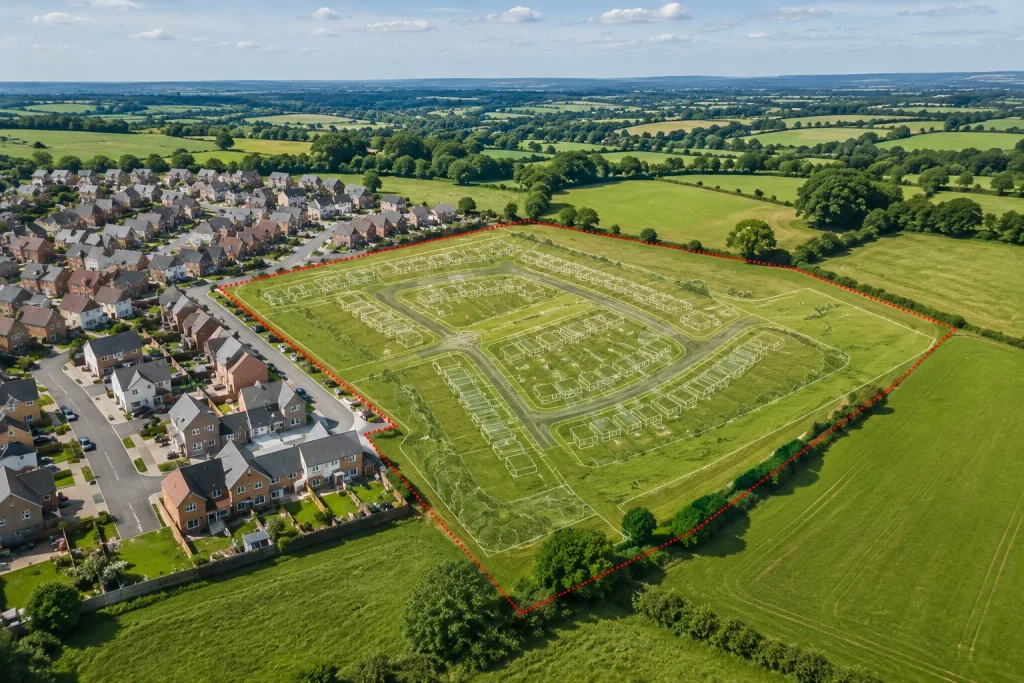
Many landowners are approached by developers offering an option agreement but have little understanding of how these agreements work or whether they represent the best route forward.
Option agreements are one of the most common methods used by developers to secure development land. They can offer advantages for both parties, but they also come with risks and long-term implications that should be fully understood before signing.
This guide explains how option agreements work, who pays the planning costs, how land values are assessed and whether an option agreement may be suitable for your land.
The short answer
An option agreement gives a developer the right to buy your land at a future date — usually after planning permission is secured — at their cost and risk. They can work well, but they’re not always the best route. Whether an option agreement, land promotion, or outright sale delivers the most value depends entirely on your site. Getting independent advice before you sign anything is essential.
What Is An Option Agreement?
An option agreement is a legal contract between a landowner and a developer.
The agreement gives the developer the right—but not the obligation—to purchase the land at a future date, usually after planning permission has been secured.
In return for this right, the developer will typically agree to pursue planning permission for the site at their own cost and risk.
If planning permission is successfully obtained, the developer can then choose whether to exercise the option and purchase the land.
If the developer decides not to exercise the option, ownership remains with the landowner. The precise terms of an option agreement will vary, particularly the option period, purchase price mechanism, planning obligations and the circumstances in which the option can be exercised. During the option period, the developer will usually have the exclusive right to decide whether to exercise the option in accordance with the agreement. The landowner retains ownership of the land, but may be restricted from selling it to another party or agreeing an alternative arrangement during the option period.
A development option is essentially an option agreement used to secure control of land for a potential development. The developer is given the right to purchase the land if the agreed conditions are met, often following the grant of planning permission. The terms vary between agreements, so the phrase “development option” should not be taken to mean there is one standard form of contract.
Why Do Developers Use Option Agreements?
Obtaining planning permission can be expensive, time-consuming and uncertain.
Developers often use option agreements to secure control over a site before investing significant sums in planning applications, surveys and technical reports.
This allows them to assess development opportunities without committing to an immediate purchase.
For landowners, an option agreement can provide a route towards securing planning permission and unlocking land value without having to fund the planning process themselves.
An option also gives the developer time to establish whether the proposed development is financially viable before committing to the purchase. If planning permission is obtained but the scheme no longer makes commercial sense, the developer may decide not to exercise the option, subject to the terms of the agreement.
How Does An Option Agreement Work?
Although every agreement is different, the process generally follows a similar structure.
Site Assessment
The developer assesses the site’s planning potential and suitability for development.
This may involve reviewing:
- Local planning policy
- Site constraints
- Access arrangements
- Environmental considerations
- Development viability
- Market demand
Option Agreement
If both parties wish to proceed, an option agreement is negotiated.
The agreement will typically cover:
- Length of the option period
- Responsibilities of the developer
- How the purchase price will be determined
- Planning obligations
- Rights and restrictions affecting the land
- Any conditions that must be satisfied before the option can be exercised
Planning Process
The developer funds and manages the planning process.
This often includes:
- Planning consultants
- Architects
- Highways assessments
- Ecology surveys
- Drainage reports
- Technical studies
- Legal and professional fees
Planning Outcome
If planning permission is granted, the developer can decide whether to exercise the option and purchase the land.
If planning permission is refused or the scheme proves unviable, the developer may choose not to proceed.
Purchase Completion
If the option is exercised, the land is purchased in accordance with the pricing mechanism set out within the agreement.
Who Pays The Planning Costs?
One of the main attractions of an option agreement is that the planning costs are usually funded by the developer. The exact arrangements should be set out clearly in the agreement, including which costs the developer is responsible for and whether any costs can be recovered from the landowner or deducted from the eventual purchase price.
These costs can often be substantial and may include:
- Planning consultants
- Architects
- Surveyors
- Ecology reports
- Highways studies
- Drainage investigations
- Legal fees
- Technical assessments
The developer accepts this risk because they stand to benefit if planning permission is secured and the site is ultimately purchased.
What Happens If Planning Permission Is Refused?
In most cases, the landowner will not be responsible for the developer’s planning costs if planning permission is refused.
The developer generally bears the financial risk associated with pursuing planning consent.
If planning permission cannot be obtained, the option may simply expire at the end of the agreed term.
The landowner retains ownership of the land throughout the process and is not normally required to reimburse the developer for planning and consultant costs. The precise consequences of a refusal will depend on the terms of the option agreement, including any provisions dealing with extensions, appeals or alternative planning proposals.
However, every agreement is different and landowners should always seek independent legal advice before signing.
How Long Does An Option Agreement Last?
Option agreements are typically shorter-term arrangements than promotion agreements.
In most cases, option periods range between:
- 12 months and 3 years for sites with immediate or near-term planning potential
- 3 to 5 years for more complex sites where additional planning work may be required
The purpose of the option period is to provide sufficient time for the developer to pursue planning permission and assess the viability of the proposed development. For the landowner, the length of the option period is an important commercial consideration. While a longer period may give the developer more time to secure planning permission, it can also mean the land is tied to one developer for longer and may limit the landowner’s ability to pursue other opportunities during that period.
While longer option periods do exist, they are generally less common. Predicting future land values many years in advance can be challenging, making it difficult to agree fair pricing mechanisms over extended timescales.
For larger strategic sites that may require promotion through the Local Plan process over many years, a promotion agreement is often considered a more appropriate route. This is because the land can ultimately be marketed openly to multiple developers once planning permission is secured, allowing the market to determine its value at the time of sale.
How Is The Purchase Price Determined?
One of the most important aspects of any option agreement is how the eventual purchase price will be calculated.
Most modern option agreements do not use a simple fixed purchase price. Instead, the price is usually linked to the market value of the land once planning permission has been secured.
Percentage Of Market Value
The most common approach is for the purchase price to be based upon an agreed percentage of the site’s market value following planning consent.
For example:
- Independent valuation undertaken
- Market value established
- Agreed percentage applied
This approach allows the purchase price to reflect the planning permission obtained and prevailing market conditions at the time the option is exercised.
Open Market Valuation
Some agreements provide for independent valuers to determine the site’s market value at the point of sale.
This can help ensure the landowner receives a fair price based on current market conditions rather than values estimated several years earlier.
Fixed Price Options
Fixed-price options are less common for development land, particularly where planning timescales are uncertain.
While they can provide certainty, they may not fully reflect future market conditions or the value created through the planning process.
The pricing mechanism is one of the most important parts of an option agreement because it determines how the value created through the planning process is shared between the landowner and developer. Before signing, the landowner should understand exactly how the land will be valued, who will carry out any valuation, what assumptions will be used and how disagreements over value will be resolved.
What Are The Benefits Of An Option Agreement?
Option agreements can offer several advantages for landowners.
No Upfront Planning Costs
The developer generally funds the planning process.
Potential Value Uplift
Planning permission can significantly increase land value.
Reduced Financial Risk
The developer assumes the planning risk and associated costs.
Access To Development Expertise
Landowners benefit from the developer’s planning and technical resources.
Retained Ownership During The Option Period
The landowner continues to own the land until the option is exercised and a sale completes.
For some landowners, an option agreement can therefore provide a way to explore the development potential of their land without taking on the financial and practical burden of pursuing planning themselves. The trade-off is that the landowner gives the developer control over the purchase opportunity for the agreed option period.
Been approached by a developer with an option agreement?
Before you sign anything, it’s worth understanding all the routes available to you. Our free land assessment gives you an independent view of your site’s potential and whether an option agreement is likely to be the best option — or whether another route could deliver more.
Get a Free Independent Assessment →What Are The Disadvantages?
Option agreements are not suitable for every landowner.
Long Timescales
The agreement may tie up the land for several years.
Limited Market Competition
Unlike land promotion, the developer usually has exclusive rights to purchase the site.
Potentially Lower Sale Price
Because the land is sold to a single party, there may be less opportunity to create competitive bidding between multiple developers.
Complex Legal Agreements
Option agreements can be legally complex and require specialist legal advice.
An option agreement also gives the developer a degree of control over the opportunity to purchase the land during the agreed option period. While the landowner retains ownership, they may be restricted from selling the land to another party or pursuing alternative arrangements during that period, depending on the terms of the agreement.
Not sure if an option agreement is the right route for your land?
Option agreements can tie up your land for years and limit the competition for your site — which can affect the final price you achieve. In some cases, land promotion or a structured developer introduction could deliver a significantly better outcome.
Our free land assessment gives you an independent view of all the routes available, so you can make an informed decision before committing to any agreement.
Get My Free Land Assessment →Takes 2 minutes · No cost · No obligation · Reviewed personally by our team
Option Agreements vs Land Promotion
Landowners often ask whether an option agreement or promotion agreement is the better route.
The key difference is what happens after planning permission is secured.
Option Agreement
- Developer controls the purchase right
- Developer seeks planning permission
- Sale is usually to a single buyer
- Typically suited to shorter-term opportunities
Promotion Agreement
- Promoter funds and manages planning
- Site is marketed openly once planning permission is secured
- Multiple developers can compete to purchase the site
- Often better suited to larger strategic opportunities
- Sale value is determined by the market at the point of sale
Neither approach is automatically better.
The most appropriate strategy depends on the site, planning prospects, timescales and the landowner’s objectives.The key consideration is not simply which agreement is easier to arrange, but which route is most likely to maximise the value you ultimately receive from the land while giving you an acceptable level of control and risk.
Option Agreement vs Outright Sale
An option agreement gives a developer time to pursue planning and the right to buy the land later if the agreed conditions are met. An outright sale, by contrast, transfers ownership immediately and gives the landowner certainty that the sale has completed without tying the land to a developer for an option period.
An outright sale may therefore be attractive where a landowner values certainty and wants to realise the value of the land now. However, if the land has significant development potential that has not yet been fully explored, agreeing a sale too early may mean the landowner does not fully understand the value that could potentially be achieved.
The right approach depends on the site’s planning potential, the level of developer interest, the landowner’s timescales and objectives, and the price being offered.
Is An Option Agreement Right For Your Land?
Option agreements can work well for certain sites and landowners, particularly where a developer is willing to fund planning costs and take on development risk.
However, every site is different. An option may be worth considering where the planning potential is reasonably clear, the developer is prepared to fund and manage the planning process, and the proposed pricing mechanism provides a fair way of sharing the value created. It may be less attractive where there is strong developer demand for the site and an open-market sale or promotion strategy could create competition between potential purchasers.
In some cases, land promotion, strategic marketing, a developer introduction or even an outright sale may provide a better outcome. See more about your options here
Before entering into any agreement, it is important to understand all available options and seek independent advice.
Many landowners are approached by developers before they’ve had a chance to understand what their land could realistically achieve — or what other routes might be available to them. Signing an option agreement without that context can mean accepting less than your land is worth.
At Revive Estates Group, we provide a free, no-obligation land assessment to help you understand your site’s potential and identify the most appropriate route — whether that’s an option agreement, land promotion, a developer introduction, or something else entirely.
Request Your Free Land Assessment →No cost. No obligation. Every enquiry is reviewed personally by our team — we’ll tell you honestly whether your land has potential worth exploring.