
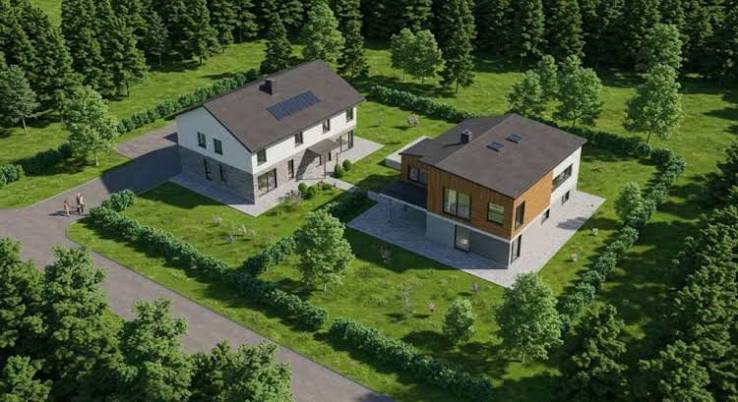
Yes, an existing residential plot can sometimes accommodate more homes, but there is no automatic right to increase the number of dwellings simply because the land is already residential. The planning authority will consider matters including the site’s location, planning policy, density, access, layout, character, privacy, parking, drainage, infrastructure and whether the proposed development would create a well-designed place.
Many homeowners and landowners own residential plots that are larger than they need or contain land that appears underused.
This might include:
- a large garden behind an existing house
- a large corner plot
- an oversized residential plot
- land beside an existing house
- a former garden that may be capable of being separated
- a site where an existing house could potentially be replaced by several homes
- an underused residential site within an established settlement.
The question is whether the planning system could support a more intensive use of the site.
Under the current 2026 National Planning Policy Framework, making efficient use of land is an important planning objective. Within settlements, residential and mixed-use proposals should contribute to an increase in the density of the area unless there is a clear justification why this would be inappropriate or impossible. :chatgpt-content-reference{index=”1″}
That does not mean every large residential garden or plot should be developed. The circumstances of each site matter.
Can you build multiple homes on one residential plot?
Potentially, yes.
A single existing residential plot can sometimes be redeveloped or subdivided to create more than one dwelling.
Possible development approaches include:
- building a new house within part of a large garden
- subdividing a residential plot
- replacing one existing house with several homes
- developing a side garden or rear garden
- creating infill development between existing properties
- redeveloping an unusually large residential site
- using a larger plot to create a small group of houses.
However, planning permission is normally required for a material change of use, subdivision or new residential development unless a particular permitted development right or other consent applies.
The fact that the existing property is residential is therefore helpful context, but it does not automatically establish that additional homes are acceptable.
What does the 2026 NPPF say about making better use of residential land?
The current NPPF places significant emphasis on making effective and efficient use of land.
Policy L3 states that development proposals should make efficient use of land, taking account of:
- the need for different types of housing
- local market conditions
- infrastructure availability
- connectivity
- the potential to improve sustainable transport
- the existing character of the area
- the need for well-designed, attractive and healthy places.
Within settlements, residential and mixed-use development should contribute to increasing the density of the area unless there is a clear justification that this would be inappropriate or not possible.
The NPPF therefore supports the principle of making better use of suitable land, but it does not remove the need to produce an acceptable development proposal. :chatgpt-content-reference{index=”2″}
Does being in a residential area mean you can automatically build more homes?
No.
Being inside an established residential area can be an important factor, but it is only one part of the planning assessment.
A planning authority may consider whether the proposed development:
- fits the character of the surrounding area
- uses the site efficiently
- provides acceptable living conditions
- has suitable access
- provides adequate parking
- avoids unacceptable overlooking
- provides sufficient daylight and outlook
- has an appropriate layout
- can be adequately drained
- can be supported by local infrastructure.
The current NPPF also requires development proposals to respond to the history, character and features of their site and surroundings and to create well-designed places. :chatgpt-content-reference{index=”3″}
Can a large garden be used to build another house?
Sometimes.
A large garden may provide an opportunity for additional residential development, particularly where it is located within an established settlement and has suitable access and a relationship with surrounding development.
But garden size alone is not enough.
A large garden might still be unsuitable because of:
- poor access
- an awkward site shape
- significant trees
- flood risk
- ecological constraints
- heritage considerations
- overlooking or privacy issues
- the relationship with neighbouring properties
- local design policies
- an important open-space or landscape function.
This is why a large garden should be assessed as a potential development site rather than simply judged by its area.
If your land is specifically a large garden, our dedicated guide Can I Build in My Garden? looks at that question in more detail.
Can you replace one house with several houses?
Potentially, yes.
In some circumstances, an existing house occupies a relatively large plot and the site could theoretically accommodate several smaller dwellings.
For example, a redevelopment proposal might involve:
- demolishing the existing house
- reorganising the site
- creating a new access arrangement
- building several new houses.
This can be an efficient use of land where the surrounding area and planning policies support a more intensive form of development.
However, the existing house’s footprint does not determine the number of replacement homes that can be built.
The planning authority will assess the proposed scheme as a whole.
What is residential infill development?
Residential infill generally refers to development that makes use of gaps or underused land within an established built-up area.
Examples can include:
- a gap between existing houses
- a large side garden
- an unusually deep residential plot
- an underused piece of land surrounded by development
- a site where redevelopment could complete an established pattern of development.
Infill can sometimes be easier to consider from a planning perspective than development in an isolated countryside location, because the principle of residential development may already be more established.
But there is no automatic right to infill development.
The design and relationship with surrounding properties remain important.
How many homes can you build on an existing residential plot?
There is no universal number.
The number of homes that might be appropriate depends on the characteristics of the site.
For example, a plot might theoretically accommodate two homes, while a much larger site could potentially support several.
The assessment should consider:
- the gross and net developable area
- the site’s shape
- the surrounding density
- the local character
- access arrangements
- parking requirements
- private amenity space
- building separation
- topography
- trees and landscape
- drainage
- other physical constraints.
It is therefore better to ask “What level of development can this site realistically support?” rather than starting with a predetermined number of houses.
Does higher density mean you can always build more houses?
No.
The current NPPF encourages efficient use of land and increased density within settlements, but it also says that existing character should be taken into account.
The policy specifically recognises that higher density may be inappropriate or impossible in some circumstances.
For example, a proposal may be too intensive if it creates unacceptable effects on neighbouring properties or produces a poorly designed layout.
The objective is therefore not simply to squeeze as many houses as possible onto a site.
It is to make appropriate and efficient use of land while creating a well-designed development.
What will the council look at when considering more homes on a plot?
A residential intensification proposal can involve many different planning considerations.
1. Location
Where the site sits within the settlement can be important.
A site close to shops, services, employment, public transport and other facilities may have advantages over a poorly connected location.
2. Existing character
The surrounding pattern of development matters.
This could include:
- building heights
- plot sizes
- building lines
- street pattern
- density
- garden sizes
- building types.
However, current national policy makes clear that existing character should not automatically prevent development that makes better use of an area’s potential. :chatgpt-content-reference{index=”4″}
3. Access and highways
A site needs an appropriate means of access.
Adding several homes may require a different access arrangement from the existing property.
Visibility, road safety, pedestrian access, parking and the effect on the highway network may all need to be considered.
4. Privacy and overlooking
New development should provide acceptable living conditions for both new and existing residents.
Windows, balconies, gardens and building orientation can therefore be important.
5. Daylight, sunlight and outlook
The layout needs to provide appropriate living conditions for the proposed homes and avoid unacceptable impacts on neighbouring properties.
6. Drainage and utilities
Additional dwellings can increase demand for drainage and utilities.
The availability and capacity of infrastructure can therefore affect the suitability of a proposal.
7. Trees, ecology and landscape
Trees and ecological features can constrain where buildings, roads and gardens can be positioned.
Removing a large amount of established vegetation simply to increase the number of houses may create additional planning issues.
Can you build more homes on a plot outside a settlement?
This is generally a more difficult question.
The fact that a site contains an existing house does not automatically mean that additional houses can be built in the surrounding countryside.
National policy seeks sustainable patterns of development and limits development away from settlements where this would undermine the intrinsic character and beauty of the countryside. :chatgpt-content-reference{index=”5″}
The planning position will therefore depend heavily on the site’s location and the relevant development plan policies.
A plot on the edge of an established settlement may have a very different planning context from an isolated rural dwelling surrounded by open countryside.
What if the site is already developed?
Previously developed land can sometimes offer opportunities for more intensive development.
The current NPPF specifically encourages development plans to identify opportunities to redevelop or make more effective use of previously developed land.
However, previously developed land does not automatically mean that residential redevelopment will be approved.
Planning policy, the site’s location, constraints and the proposed development still need to be considered.
Could a residential plot be worth more if it can accommodate several homes?
Potentially, yes.
If a site has credible potential to accommodate additional dwellings, that potential can affect its market value.
But it is important not to assume that the value of the land is simply the value of the completed houses minus a fixed amount.
A developer would normally consider:
- the likely sales value of the completed homes
- construction costs
- professional fees
- finance costs
- planning and infrastructure costs
- abnormal costs
- developer return
- planning risk
- the time required to obtain permission and complete the development.
The potential number of homes is therefore only one part of the valuation.
Should you apply for planning permission before selling the land?
Not necessarily.
A landowner may have several options, depending on the circumstances.
These could include:
- selling the land in its existing state
- obtaining planning advice first
- submitting a planning application
- marketing the site with identified development potential
- working with a planning consultant or land promoter
- considering a conditional sale or option arrangement.
The best route depends on the site’s potential, the landowner’s objectives, timescale and appetite for planning risk.
If you are considering whether to progress planning or sell now, our guide Is Land Promotion Better Than Selling Land Now? explains some of the key considerations.
What should you check before trying to build more homes?
Before spending significant money on a planning application, it is sensible to establish whether the site has a realistic prospect of supporting additional development.
A useful initial checklist includes:
- Is the site within an established settlement?
- What does the Local Plan say about the area?
- Is the site already residential or previously developed?
- What is the surrounding density?
- Could the site accommodate an appropriate access?
- Are there significant trees or ecological constraints?
- Is the site affected by flood risk?
- Can drainage and utilities be accommodated?
- Would additional development fit the character of the area?
- Could neighbouring properties experience unacceptable impacts?
- What level of development could realistically be achieved?
- Would the development be commercially viable?
Could your existing residential land have development potential?
If you own a large residential plot, garden, side land or another underused residential site, it may be worth investigating whether the land could support additional homes.
The important point is to assess the whole development opportunity rather than simply asking how large the garden or plot is.
At Revive Estates Group, we can assess land from a planning and development perspective and help identify the opportunities and constraints that may need further investigation.
Could Your Residential Land Have Development Potential?
If you own a large garden, residential plot or underused site and want an initial view of its development potential, you can request a free land assessment.
Request a Free Land AssessmentFrequently Asked Questions
Can I build more than one house on my existing residential plot?
Potentially. A residential plot can sometimes be subdivided or redeveloped to create additional homes, but planning permission will normally be required and the proposal must satisfy relevant planning policies and site-specific requirements.
Can I build another house in my garden?
Sometimes. A large garden may have development potential, particularly where it is within an established settlement and has suitable access, but garden size alone does not guarantee that planning permission will be granted.
Does the 2026 NPPF encourage higher residential density?
Yes. Current NPPF policy L3 says residential and mixed-use development within settlements should contribute to an increase in the density of the area unless there is a clear justification why this would be inappropriate or not possible. Existing character must still be taken into account.
How many houses can I build on one plot?
There is no fixed number. The appropriate number depends on the site’s size, shape, access, surrounding density, character, infrastructure, design and other planning constraints.
Can I replace one house with several houses?
Potentially. Redevelopment of an existing residential plot can sometimes provide an opportunity for several homes, but the complete proposal will need to be assessed against planning policy and site-specific considerations.
Does being inside a settlement mean I can build more homes?
Being within a settlement can support the principle of residential intensification, but it does not create an automatic right to develop. The location, planning policies, design, access, infrastructure and relationship with surrounding properties still need to be considered.
Can residential land outside a settlement be developed?
It can sometimes be possible, but development outside settlements generally faces different planning considerations and national policy seeks sustainable patterns of development while protecting the countryside. The specific planning context of the site is important.
Could building more homes increase the value of my residential land?
Potentially. Credible development potential can affect land value, but the value depends on what can realistically be built, planning risk, development costs, market conditions and the time and investment required to achieve the development.
Can Revive Estates Group assess my residential plot?
Yes. Revive Estates Group can provide an initial assessment of land to help establish whether it may have development potential and what planning considerations may need further investigation.
Want to discuss your land?
If you own a residential plot, large garden or underused site and believe it may have development potential, contact Revive Estates Group.