
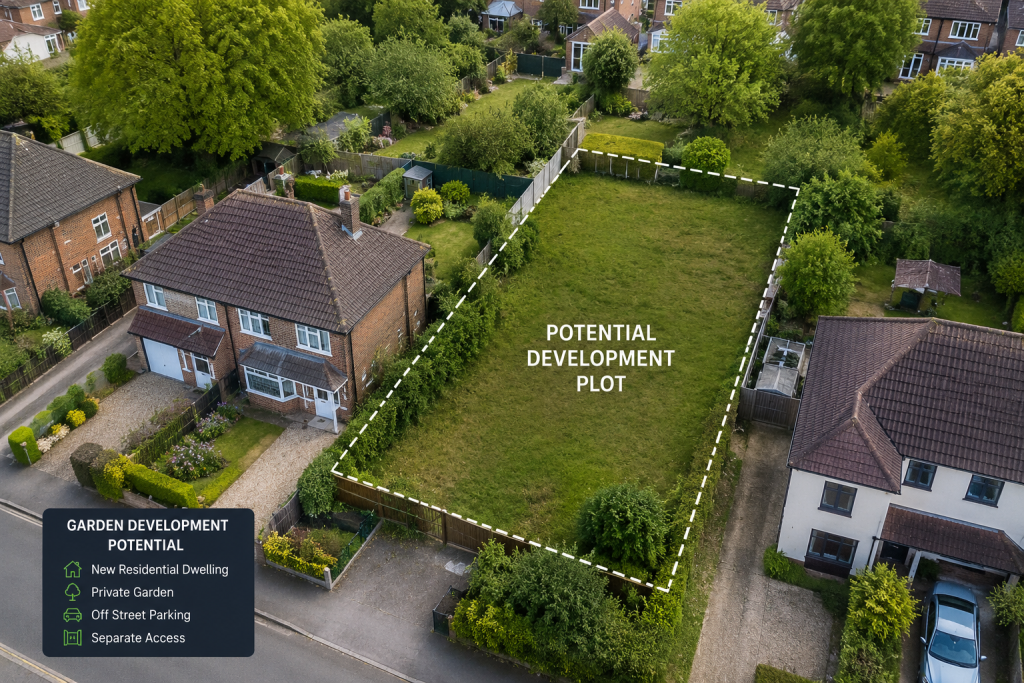
Can I Build in My Garden? A 2026 Planning Guide
Can I Build in My Garden? A 2026 Planning Guide
If you own a house with a large garden, you may be wondering whether part of that garden could be used to build another home.
The answer depends on the planning circumstances of your particular site. Location, the relationship with the existing settlement, local and national planning policy, the character of the area, access, layout, neighbouring properties and other site constraints can all affect whether garden development is appropriate.
The 2026 National Planning Policy Framework (NPPF) places greater emphasis on making effective use of land, including appropriate opportunities for development within existing residential areas and curtilages. However, this does not mean that every garden is suitable for development or that planning permission will automatically be granted.
This guide explains what to consider if you are thinking about building in your garden, how planning authorities assess garden development, and how you can establish whether your particular plot may have genuine development potential.
The Short Answer
Yes, potentially — but there is no automatic right to build a separate house in your garden. A new dwelling will normally require planning permission, and the proposal will be assessed against the relevant national and local planning policies together with the characteristics and constraints of the site.
Garden development can sometimes work particularly well where a plot is within an established settlement, has suitable access and can accommodate a well-designed dwelling without causing unacceptable harm to neighbouring properties or the character of the area.
The important question is therefore not simply “Is my garden big enough?” but “Is my garden in a location and configuration where development could be acceptable?”
What Does “Building in Your Garden” Mean?
Garden development usually means using part of the land within the residential curtilage of an existing home to accommodate additional development, such as a new dwelling.
Depending on the location and layout of the site, this can take different forms. You may hear terms such as:
- Garden plot development — using part of an existing garden as a separate development site.
- Infill development — developing an underused plot within an established built-up area, where the proposal fits appropriately within the surrounding pattern of development.
- Backland development — development positioned behind existing properties, often accessed from a side road, shared access or a new access arrangement.
- Residential intensification — making more effective use of land within an existing residential area or curtilage.
These terms can overlap, but they do not automatically mean that planning permission will be granted. The planning authority will consider the individual site’s location, relationship with surrounding development, character, access, layout, neighbouring properties and other relevant planning considerations.
The 2026 National Planning Policy Framework (NPPF) places greater emphasis on making effective use of land, including appropriate opportunities to make better use of land within existing settlements and residential areas. This can support well-designed garden and infill development where the planning circumstances are suitable.
However, there is no simple minimum garden size or national rule that means a particular garden can be developed. The suitability of each site needs to be considered on its own planning merits.
Can You Legally Build a House in Your Garden?
Potentially, yes — but a new, separate dwelling in your garden will normally require planning permission.
The fact that land forms part of an existing residential garden does not automatically prevent development. Equally, there is no national rule that gives homeowners an automatic right to build another house simply because they have a large garden.
Under the 2026 National Planning Policy Framework (NPPF), planning policy places greater emphasis on making effective use of land and supporting appropriate intensification within existing settlements. This can include additional development within residential curtilages where the proposal is suitable for its location and surroundings. The policy does not remove the need to consider the individual planning circumstances of the site.
When a planning application is assessed, the key question is therefore whether the proposed development represents an appropriate use of the particular plot, taking account of its location, surroundings, design and site constraints.
1. Location and Relationship with the Existing Settlement
Where your garden is located can be more important than its size.
A garden within an established town or village may have different planning prospects from a garden on the edge of a settlement or within a rural area. Planning professionals will consider the site’s relationship with surrounding development, the settlement pattern, access to services and the relevant local planning policies.
Sites that form part of an established built-up area can sometimes provide opportunities for appropriate infill or residential intensification, provided the proposal fits the character and circumstances of the area.
2. The Size, Shape and Layout of the Garden
There is no fixed national minimum garden size that automatically determines whether another dwelling can be built.
Instead, the available land needs to be capable of accommodating an appropriate development while providing satisfactory access, parking, private amenity space and acceptable living conditions for both the new and existing homes.
The shape and configuration of the plot can therefore be just as important as its overall area. A smaller but well-configured plot with independent access may have greater potential than a larger garden with difficult access or significant constraints.
3. Access, Parking and Highways
Safe and suitable access is an important consideration for garden development.
The assessment may consider:
- How vehicles and pedestrians would reach the proposed dwelling.
- Whether a safe entrance can be provided from the existing highway or access.
- Whether adequate parking can be accommodated.
- Whether the proposal would create unacceptable highway safety issues.
- Whether emergency access and servicing requirements can be met where relevant.
A property with an existing side access, rear access or frontage capable of accommodating a separate entrance may offer more options, but access arrangements need to be assessed on their individual merits.
4. Character, Design and Neighbouring Properties
The design and positioning of a new dwelling will need to respond appropriately to the surrounding area.
Planning considerations can include:
- The established pattern and density of development.
- The scale, height and appearance of the proposed building.
- Its relationship with neighbouring properties.
- Privacy, overlooking and outlook.
- Daylight and sunlight.
- Private outdoor amenity space.
- The effect of the development on the character and appearance of the area.
The 2026 NPPF supports making effective use of land, but this is not a requirement to maximise the number of homes on every garden plot. Development still needs to be appropriately designed and related to its surroundings.
5. Planning Designations and Local Policy
The planning designation affecting your property can materially change the assessment.
For example, additional considerations may apply where a garden is:
- Within the Green Belt.
- Within or close to a conservation area.
- Within a protected landscape or other designated area.
- Affected by a local planning policy restricting backland or infill development.
- Subject to specific site allocations, designations or other planning constraints.
Local planning policies remain important because planning applications are normally determined in accordance with the development plan unless material considerations indicate otherwise. The national NPPF therefore needs to be considered alongside the relevant local planning framework.
If your garden is within the Green Belt, the assessment is different from an ordinary garden plot because Green Belt policies impose additional controls on development. That does not mean every garden within the Green Belt is automatically incapable of development, but the relevant Green Belt policies and any applicable exceptions need to be considered.
6. Flood Risk, Ecology and Other Site Constraints
Physical and environmental constraints can affect whether a garden plot is suitable for development and how a scheme would need to be designed.
Depending on the site, this can include:
- Flood risk and drainage.
- Trees and root protection areas.
- Protected species and ecological constraints.
- Existing buildings or structures.
- Topography and ground conditions.
- Heritage considerations.
- Utilities and infrastructure.
These issues do not necessarily prevent development, but they can affect the layout, scale, cost and planning prospects of a proposal.
7. Biodiversity Net Gain
Where the statutory Biodiversity Net Gain (BNG) requirements apply, development will generally need to achieve at least a 10% increase in biodiversity value.
However, the rules include exemptions. From 6 August 2026, certain planning applications where the red-line site area is 0.2 hectares or below are exempt from the statutory BNG requirement, subject to the applicable conditions, including provisions relating to priority habitat.
This can be particularly relevant when considering smaller garden development sites, but the exemption should be checked against the specific proposal rather than assumed simply because a garden plot is small.
Checking environmental constraints and BNG requirements at an early stage can therefore help establish whether a garden development opportunity is realistic and what technical work may be required.
Do You Need Planning Permission to Build in Your Garden?
If you want to build a separate new dwelling in your garden, you will normally need planning permission from the local planning authority.
Permitted development rights can allow certain forms of development within the curtilage of a house without a full planning application, but these rights are subject to specific rules and limitations. They do not generally provide a route for simply building a new, independent house in your garden.
It is therefore important to establish exactly what type of development you are considering before assuming that planning permission is or is not required.
Examples of Development That May Follow Different Planning Routes
- A new standalone house — normally requires a full planning application.
- An extension to the existing house — may in some circumstances fall within householder permitted development rights, subject to the relevant conditions and limitations.
- An outbuilding or garden building — some forms of outbuilding may benefit from permitted development rights, depending on their use, size, position and other requirements.
- An annexe or accommodation connected with the existing home — the planning position depends on its design, use and relationship with the main dwelling.
Even where permitted development rights may apply, there can be important restrictions, exclusions or prior approval requirements. Conservation areas, listed buildings, designated land and other circumstances can also affect what rights are available.
Other Approvals and Technical Matters
Planning permission is only one part of the process. Depending on the proposal, you may also need to consider:
- Building Regulations approval for the construction works.
- Drainage and surface water requirements.
- Highways and access considerations.
- Ecology, trees or biodiversity requirements.
- Party wall matters where relevant.
- Utility connections and infrastructure.
The precise requirements will depend on the development proposed and the characteristics of the site.
How Much Is Garden Land Worth to Developers?
The value of garden land can vary significantly depending on whether it has genuine development potential and what could realistically be built on the site.
A garden with no realistic prospect of separate development will generally be valued as part of the existing residential property. A garden that could accommodate an additional dwelling may have a different value because it represents a potential development opportunity.
Factors that can affect the value of a garden development site include:
- Location — local property values and demand for new homes.
- Planning prospects — the likelihood of obtaining an acceptable planning consent.
- Development capacity — the number and type of homes that could realistically be accommodated.
- Access — whether suitable independent or shared access can be provided.
- Site constraints — including trees, flood risk, ecology, drainage and other matters.
- Development costs — including construction, infrastructure, professional fees and any abnormal costs.
- Planning status — whether the land already benefits from planning permission or has another established development route.
This is why it is difficult to put a meaningful value on garden land simply by looking at its size. Two gardens of similar dimensions can have very different development values because their planning circumstances and development potential are different.
If you want to understand the factors that can influence development land value in more detail, see our guide to how much land can be worth to a developer.
Could Your Garden Have Development Value?
Before thinking about the value of a garden plot, it is important to establish whether there is a realistic development opportunity in the first place.
Our free land assessment reviews the planning position, location, access, constraints and potential development options for your particular site.
Get a Free Garden Plot Assessment →
No cost · No obligation · Reviewed personally by our team
What Types of Development Can Be Built in a Garden?
Garden development does not necessarily mean building one particular type of house. The form of development that may be appropriate depends on the size and configuration of the site, its surroundings, access, planning policy and the character of the area.
Depending on the circumstances, a garden or residential curtilage may potentially accommodate:
- A detached house on a separate garden plot.
- A semi-detached or terraced dwelling where the site and surrounding pattern of development support this form of development.
- A bungalow, particularly where a lower building form is appropriate to the surroundings.
- Infill or backland development within an established residential area.
- More than one dwelling on a larger or appropriately configured site, where the scale and layout are acceptable.
- An annexe or ancillary accommodation associated with the existing home, where the proposed use and relationship with the main dwelling are appropriate.
The fact that a particular type of development can physically fit on a garden plot does not mean that it will necessarily be acceptable in planning terms. The proposed use, scale, layout, access, design and relationship with neighbouring properties all need to be considered.
For larger gardens, the opportunity may therefore be more than simply asking whether there is enough room for another house. The more useful question is what form and scale of development could be appropriate for the particular site.
Common Reasons Garden Developments Are Refused
Garden development is not automatically acceptable simply because there appears to be enough space for another property. Planning applications are assessed against the relevant planning policies and the circumstances of the individual site.
Common issues that can affect garden development proposals include:
- Inappropriate scale or overdevelopment — the proposal may not fit comfortably within the established pattern, density or character of the area.
- Poor access or highway safety — suitable access, parking and servicing may not be achievable.
- Impact on neighbouring properties — overlooking, loss of privacy, unacceptable outlook, or harmful effects on daylight and sunlight can be important considerations.
- Design and character — a building may be considered inappropriate in terms of its scale, appearance, position or relationship with surrounding development.
- Trees, ecology or biodiversity — protected trees, habitats, species or other ecological constraints can affect the principle or design of development.
- Flood risk and drainage — flood risk or inadequate drainage arrangements can constrain the location, layout or type of development that may be appropriate.
- Planning designations — Green Belt, conservation areas, listed buildings and other designations can introduce additional planning considerations.
- Local planning policy — local policies may contain specific requirements relating to infill, backland development, residential intensification, design, parking or neighbourhood character.
Importantly, identifying one of these issues does not necessarily mean that development is impossible. Sometimes the design, scale, access arrangement or proposed use can be changed to respond to a particular constraint.
This is why it can be useful to assess the planning position before spending money on detailed architectural drawings or submitting an application.
Could Your Garden Have Development Potential?
Not sure whether your garden could accommodate another home? Our free land assessment reviews your site’s planning position, location, access and potential constraints to give you an honest view of whether development is worth exploring.
Get My Free Land Assessment →No cost · No obligation · Reviewed personally by our team
How to Find Out If Your Garden Has Development Potential
The best way to establish whether your garden could be suitable for development is to assess the planning position of the specific site before committing to detailed design work or a planning application.
An initial assessment can consider:
- Location and settlement relationship — how the garden relates to the surrounding built-up area and existing pattern of development.
- Planning policy — the relevant national and local planning policies and any designations affecting the site.
- Site size and configuration — whether the land could accommodate an appropriately designed development while retaining suitable space for the existing and proposed properties.
- Access and highways — whether safe and practical vehicle and pedestrian access could be provided.
- Neighbouring properties and character — the potential relationship with surrounding homes, including privacy, overlooking, scale and appearance.
- Environmental and physical constraints — including flood risk, drainage, trees, ecology, heritage and other site-specific matters.
- Potential development options — what type and scale of development may be appropriate and whether there appears to be a realistic planning route.
- Market and development considerations — whether the potential development is likely to be commercially meaningful once the likely costs and constraints have been considered.
This does not replace a formal planning application or detailed technical surveys. Instead, it provides an early indication of whether the site appears to have a realistic opportunity worth investigating further.
For many landowners, this early assessment can help avoid spending money on detailed plans for a site that has significant planning constraints, while identifying opportunities that may justify further investigation.
What Are Your Options If Your Garden Has Development Potential?
If your garden appears capable of accommodating additional development, there are several routes you could consider. The most appropriate option will depend on your circumstances, the planning prospects of the site and what you want to achieve.
Potential options include:
- Developing the site yourself — you may choose to obtain planning permission and build the property yourself, either for occupation or sale.
- Selling the garden plot — where there is a realistic development opportunity, you may be able to sell part of the garden as a separate development site.
- Selling subject to planning — an agreement can sometimes be structured so that the purchaser seeks planning permission before completing the purchase.
- Land promotion — where a site has longer-term potential, a land promoter may take responsibility for pursuing planning opportunities, with the landowner retaining an interest in the future value of the site.
- Option or other contractual arrangements — depending on the circumstances, an appropriate agreement may allow a developer or other party to pursue the opportunity while protecting the landowner’s position.
Each route involves different levels of risk, control, timescale and potential return. There is therefore no single approach that is right for every garden development opportunity.
The important first step is to establish whether the garden has a realistic development opportunity and what type and scale of development might be appropriate. Once that is understood, you can make a more informed decision about what to do with the land.
If you’re wondering whether you can build in your garden, the next step is to understand whether your particular plot has genuine development potential. A free assessment can help you understand the planning opportunities and constraints affecting your site before you commit to detailed plans or other professional costs.
At Revive Estates Group, we review garden plots, residential curtilages and infill opportunities across the UK. We’ll give you an honest view of whether your site appears worth exploring further and what potential routes may be available.
Request Your Free Land Assessment →No cost. No obligation. Every enquiry is reviewed personally by our team.
Frequently Asked Questions
Can I build a second house in my garden in the UK?
Potentially, yes. A new, separate dwelling in your garden will normally require planning permission. Whether permission is achievable depends on the location of the site, its relationship with surrounding development, local and national planning policy, access, design, neighbouring properties and other site-specific constraints.
How big does my garden need to be to build a house?
There is no fixed national minimum garden size for building a new house. The important question is whether the available land can accommodate an appropriately designed development with suitable access, parking, amenity space and acceptable relationships with existing and neighbouring properties.
Can I build a house in my garden if it is in the Green Belt?
Green Belt land is subject to additional planning controls, but being within the Green Belt does not automatically mean that development is impossible. The planning position depends on the specific circumstances of the site, the proposed development and the applicable Green Belt policies and exceptions.
A garden within the Green Belt should therefore be assessed differently from an ordinary garden plot outside the Green Belt.
Does garden land count as brownfield or previously developed land?
Not necessarily. Existing residential garden land should not automatically be described as previously developed land simply because it forms part of a built-up property. The planning definition of previously developed land has specific requirements, and gardens need to be considered carefully in their planning context.
This distinction can be particularly important where Green Belt or other planning policies relating to previously developed land are being considered.
How can I find out if my garden is suitable for development?
The best starting point is an assessment of the individual site. This can consider the planning policy position, settlement relationship, site layout, access, neighbouring properties, environmental constraints and the type and scale of development that may be appropriate.
A free initial land assessment can help you understand whether your garden appears to have development potential before you commit to detailed plans or significant professional costs.