
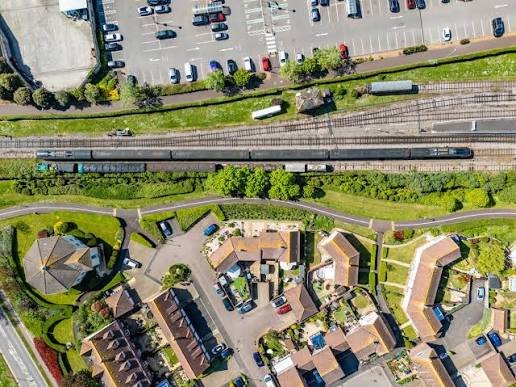
The short answer
Under the 2026 National Planning Policy Framework (NPPF), a reasonable walking distance for relevant station-led development is around 800 metres, or around a 10-minute walk. However, this is not simply a straight-line 800-metre radius on a map. Topography, the availability and quality of walking routes and physical barriers can affect what is considered a reasonable walking distance. The station must also meet the NPPF definition of a well-connected station.
How Close Does Land Need to Be to a Railway Station for Development?
The 2026 NPPF defines a reasonable walking distance for certain station-led development policies as around 800 metres, or around a 10-minute walk.
This is important for landowners because the measurement is not intended to be treated simply as a circle drawn around a railway station.
The actual relationship between the site and the station matters. A site may be less than 800 metres away in a straight line but have no practical pedestrian route. Equally, a site that is slightly further away in a straight line may have a direct and convenient walking route.
The current NPPF therefore requires the walking-distance question to be considered in the context of the actual site and its surroundings.
What Does “Reasonable Walking Distance” Mean?
For the station-led policies in the NPPF, reasonable walking distance is defined as around 800 metres, or around 10 minutes’ walk, where certain factors do not make walking from that distance unreasonable.
The definition specifically refers to:
- topography;
- route availability;
- the quality of the available walking route; and
- physical barriers that could prevent or discourage walking.
This means that the planning assessment is concerned with real-world accessibility, rather than simply measuring the distance between two points.
Is 800 Metres Measured as a Straight Line?
No. The 800-metre figure should not simply be treated as a straight-line radius around the station.
For example, a site may be 700 metres from a station when measured directly on a map but be separated from it by a railway line, major road, river or other barrier with no convenient crossing.
In that situation, the actual walking connection could be substantially longer or less practical.
Conversely, a site may have a clear footpath or street connection providing a direct route to the station.
The important question is therefore whether the site is within a reasonable walking distance having regard to the route and physical circumstances.
What Does the NPPF Say About an 800-Metre Walking Distance?
The current NPPF’s Annex B glossary provides the definition used for policies S5, L3 and GB7.
It states that reasonable walking distance should be considered to be around 800 metres, or around 10 minutes’ walk, where topography, route availability and quality or physical barriers would not prevent or discourage walking from up to 800 metres away.
This definition is particularly important because the station-led policies use the same concept when identifying sites that may benefit from the relevant provisions.
It also means that 800 metres is a useful policy benchmark, not an automatic development boundary. :chatgpt-content-reference{index=”1″}
Does the 800-Metre Rule Apply to the Whole Site?
Not necessarily.
The current NPPF specifically addresses situations where only part of a site falls within the reasonable walking distance of the station.
Where this happens, the relevant provisions of policies S5, L3 and GB7 relating to land around well-connected stations apply only to the part of the site that falls within the reasonable walking distance.
This could be particularly important for larger parcels of land where the station is close to one boundary but considerably further from the remainder of the site. :chatgpt-content-reference{index=”2″}
How Do You Measure the Walking Distance?
A sensible initial assessment should look at the actual pedestrian route between the site and the station rather than relying solely on a straight-line measurement.
Points to consider include:
- the location of the site entrance or likely pedestrian access;
- the location of the relevant station entrance;
- existing pavements and footways;
- public rights of way;
- road crossings;
- railway crossings and underpasses;
- rivers, canals and other physical barriers;
- steep gradients and changes in topography;
- whether the route is continuous and usable; and
- whether the route provides a realistic and convenient way of reaching the station on foot.
The exact assessment will depend on the site and the route available at the time the planning decision is made.
What If There Is No Footpath to the Station?
The absence of a convenient existing footpath does not necessarily mean that the land falls outside the station-led policy.
However, it is an important consideration.
If a safe and practical pedestrian connection could be provided or improved as part of the development, that may form part of the planning assessment. The availability and quality of the route remain relevant to whether the station is genuinely accessible from the site.
Landowners should therefore look at whether a pedestrian connection is realistically achievable rather than assuming that the current route is the only possible route.
What If the Land Is 900 Metres or 1 Kilometre From the Station?
There is no simple rule that land becomes unsuitable the moment it exceeds 800 metres in a straight-line measurement.
The NPPF uses the wording “around 800 metres” and recognises that walking conditions and physical circumstances matter.
However, land that is substantially beyond the reasonable walking-distance area should not automatically be described as benefiting from the station-led provisions simply because it is relatively close to a station.
The assessment should therefore consider the actual walking route and the circumstances of the site rather than trying to identify an arbitrary cut-off point.
Does the Station Itself Have to Meet Specific Criteria?
Yes.
The 800-metre test is only part of the assessment. The current NPPF refers specifically to a well-connected station.
The definition covers railway stations and underground, tram and light rail stops located within a qualifying Travel to Work Area and served during the daytime by the required level of service, subject to the detailed criteria in the NPPF.
The current definition uses the top 80 Travel to Work Areas by Gross Value Added (GVA) with the relevant service-frequency requirements. The station must also meet the specified service test, including at least four trains or trams per hour overall or at least two per hour in any one direction during the normal weekday daytime timetable, subject to the provisions in the definition. :chatgpt-content-reference{index=”3″}
This is why being close to any railway station is not enough by itself to establish that the station-led policy applies.
Does Being Within 800 Metres Mean Planning Permission Is Likely?
No.
Being within reasonable walking distance of a qualifying station can be an important factor, but it does not guarantee planning permission.
Policy S5 also requires relevant residential or mixed-use development to:
- be physically well-related to the station or the settlement in which the station is located;
- be of a scale that can be accommodated by existing or proposed infrastructure; and
- not prejudice proposals for long-term comprehensive development in the same location.
Other planning policies and site-specific constraints can also apply.
The 800-metre distance should therefore be viewed as one part of a wider planning assessment, rather than as a right to develop. :chatgpt-content-reference{index=”4″}
What About Green Belt Land Within 800 Metres?
Green Belt land within reasonable walking distance of a well-connected station can be particularly interesting to investigate, but the station-led provisions do not simply remove Green Belt policy.
The current NPPF contains separate Green Belt policies, including specific provisions for Grey Belt and development around well-connected stations.
Where a site is within the Green Belt, its Green Belt status, contribution to Green Belt purposes and the other requirements of the relevant Green Belt policies need to be considered alongside the station-led provisions.
Our guide to Grey Belt under the 2026 NPPF explains the wider Green Belt position.
Why Could an 800-Metre Station Location Matter to Land Value?
Land within reasonable walking distance of a well-connected station may attract interest because the location can support a more sustainable pattern of development and, where the relevant policies apply, provide a specific planning opportunity.
However, proximity to a station does not create a standard land value or development value.
The potential value will still depend on what can realistically be developed, planning risk, infrastructure, development costs, market conditions and the characteristics of the site.
A site 500 metres from a station is not automatically worth more than a site 900 metres away. The wider planning circumstances can be much more important than the distance alone.
What Should Landowners With Land Near a Railway Station Check?
If you own land near a railway station, the following initial checks can help establish whether the station-led provisions may be relevant:
- Is the station a “well-connected station” under the current NPPF?
- What is the actual walking route from the site to the station?
- Is the site within around 800 metres or around 10 minutes’ walk?
- Are there barriers or poor-quality routes that affect accessibility?
- Does the entire site fall within the reasonable walking-distance area, or only part of it?
- Is the site physically well-related to the station or surrounding settlement?
- Can the proposed scale of development be supported by existing or proposed infrastructure?
- Is the site inside the Green Belt or another protected designation?
- Are there flood, ecological, landscape or heritage constraints?
- What does the Local Plan say about the site and surrounding area?
These checks do not establish that planning permission will be granted, but they can help determine whether the site warrants more detailed investigation.
Own land within walking distance of a railway station?
Our free land assessment can review the site’s location, planning position and relationship with the surrounding area and give you an honest initial view of whether its development potential is worth investigating.
Get a Free Land Assessment →Frequently Asked Questions
How close does land need to be to a railway station for development?
For the relevant station-led policies in the 2026 NPPF, a reasonable walking distance is around 800 metres, or around a 10-minute walk. Topography, route availability and quality and physical barriers can affect the assessment.
Is 800 metres measured in a straight line?
No. The assessment should consider the reasonable walking distance and the actual route between the site and station. A straight-line measurement alone does not take account of roads, rivers, railway lines, gradients or other barriers.
What is a reasonable walking distance under the NPPF?
For the station-led provisions in policies S5, L3 and GB7, the NPPF defines reasonable walking distance as around 800 metres or around 10 minutes’ walk, subject to the topography, route availability and quality and physical barriers.
What if only part of my land is within 800 metres?
The NPPF specifically provides that where only part of a site falls within the reasonable walking distance, the relevant station-led provisions apply only to the part of the site within that distance.
Does every railway station qualify for station-led development?
No. The station must meet the NPPF definition of a well-connected station. This includes specific requirements concerning its Travel to Work Area and daytime rail service frequency.
Can land more than 800 metres from a railway station be developed?
Potentially. Being outside the reasonable walking-distance area does not mean that land cannot be developed under any circumstances. It means that the specific station-led provisions based on reasonable walking distance may not apply to that part of the site.
Can Green Belt land within 800 metres of a railway station be developed?
Potentially, but Green Belt policies still apply. The current NPPF contains specific provisions concerning Grey Belt and development around well-connected stations, so the individual site’s Green Belt and wider planning position needs to be assessed.
What Does the 800-Metre Rule Mean for Landowners?
The 2026 NPPF provides a clearer framework for considering land around well-connected stations. Around 800 metres or a 10-minute walk is the national benchmark for reasonable walking distance, but the actual pedestrian connection and physical characteristics of the site remain important.
For landowners, the key point is that distance from a station is only the starting point. The station must qualify, the site must relate appropriately to the station or settlement, infrastructure must be capable of supporting the proposed development and the other relevant planning policies must also be considered.
If you own land near a railway station, understanding the actual walking connection and the current planning position could be an important first step in assessing its potential.
Revive Estates Group provides free, no-obligation land assessments for landowners who want an honest initial view of whether their land has development potential.
Request Your Free Land Assessment →No cost. No obligation. Every enquiry is reviewed personally by our team.