
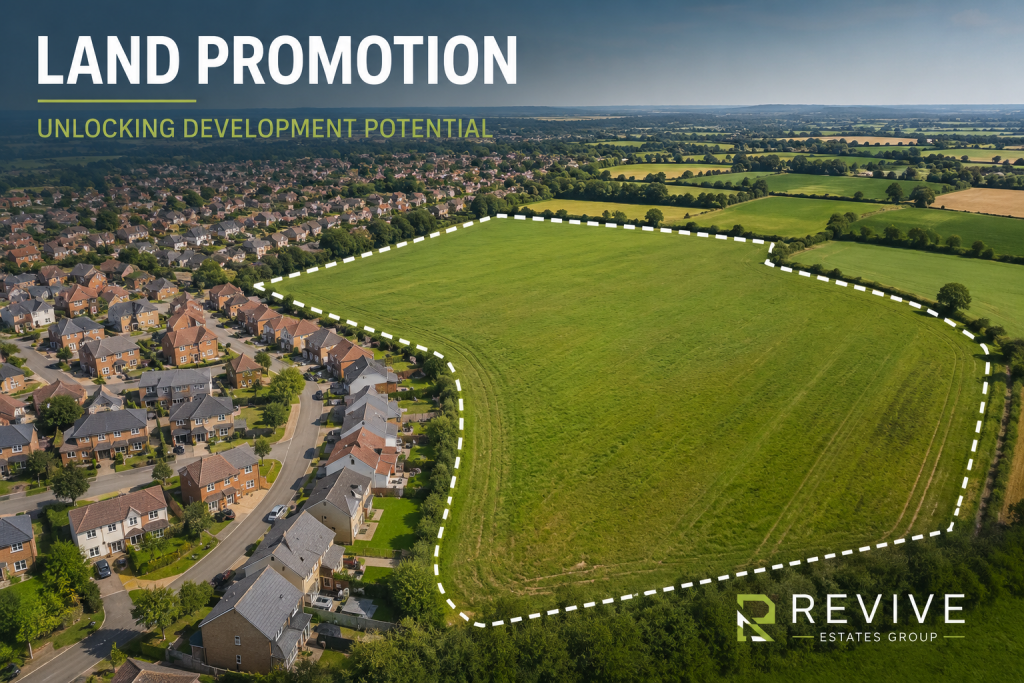
Understanding One of the Most Effective Ways to Maximise Land Value
Many landowners know their land may have development potential but are unsure how to unlock its value.
One option often discussed within the development industry is land promotion. However, many landowners have never heard the term before and may not fully understand how it works, what it involves, or whether it is the right approach for their land.
This guide explains what land promotion is, how it differs from other approaches such as option agreements and outright sales, and when it may be worth considering.
The short answer
Land promotion is where a promoter funds the planning process on your behalf, then sells your land on the open market once permission is secured — taking a share of the proceeds. It can deliver significantly more than a direct developer sale, but it’s a longer-term commitment and isn’t right for every site. Whether it’s the best route for your land depends on your specific circumstances.
What Is Land Promotion?
Land promotion is a process whereby a land promoter works with a landowner to secure planning permission for a site before it is sold.
The promoter typically funds the planning process, including consultant fees, technical reports and planning applications, in return for a share of the eventual sale proceeds once planning permission has been secured and the land is sold.
The key objective is simple:
Increase the value of the land by obtaining planning permission before it is sold.
In many cases, land with planning permission can be worth significantly more than land without planning consent.
What Is a Land Promotion Agreement?
A land promotion agreement is the contract between the landowner and the promoter that sets out how the land will be promoted, how planning will be pursued and how the proceeds from the eventual sale will be shared. The agreement will normally cover matters such as the promoter’s responsibilities, the costs they will fund, the length of the promotion period, the marketing and sale process, and how the net sale proceeds will be divided.
Unlike an option agreement, the promoter does not normally have the right to buy the land themselves. Instead, once planning permission is secured, the land is marketed to potential purchasers and the aim is to achieve the best available market price.
How Does Land Promotion Work?
Although every site is different, the process generally follows several stages.
Site Assessment
The promoter assesses the land to determine whether it may have development potential.
This involves reviewing factors such as:
- Planning policy
- Site constraints
- Access arrangements
- Environmental considerations
- Local housing demand
- Development viability
Promotion Agreement
If the site appears suitable, a promotion agreement is entered into between the landowner and promoter.
This agreement sets out how the site will be promoted and how proceeds will be shared if planning permission is secured and the land is sold.
Planning Process
The promoter funds and manages the planning process.
This may include:
- Planning consultants
- Architects
- Highways assessments
- Ecology surveys
- Drainage studies
- Public consultation
- Legal and technical advice
Sale of the Site
If planning permission is secured, the site is marketed to developers through a competitive sales process.
The objective is to achieve the highest possible sale price through open market competition.
Distribution of Proceeds
Following the sale, planning and promotion costs are recovered and the remaining proceeds are shared in accordance with the promotion agreement.
What Happens If Planning Permission Is Refused?
One of the key benefits of land promotion is that the financial risk is typically borne by the land promoter rather than the landowner.
Under a standard promotion agreement, the promoter funds the planning application and associated costs, which can often amount to tens or even hundreds of thousands of pounds depending on the size and complexity of the site.
These costs may include:
- Planning consultants
- Architects
- Ecology surveys
- Highways assessments
- Drainage reports
- Legal advice
- Technical reports
- Public consultation
If planning permission is ultimately refused and no sale takes place, the landowner would not normally be responsible for reimbursing these costs.
The promoter accepts this risk because they only recover their investment if planning permission is secured and the land is successfully sold.
This allows landowners to explore development opportunities without exposing themselves to significant planning costs.
As with any agreement, landowners should always seek independent legal advice before entering into a promotion agreement.
How Long Does A Promotion Agreement Last?
Land promotion is generally a medium to long-term strategy. The length of a promotion agreement will depend on the nature of the site, its planning prospects and the planning process involved.
Typical agreement periods are often:
- 3 to 5 years for sites with immediate or near-term planning potential
- 5 to 10 years for larger strategic sites
- Longer periods for major strategic land opportunities being promoted through the Local Plan process
What affects how long land promotion takes?
The timescale for any individual site depends on several factors that are specific to that site and its local planning context. Understanding these factors before entering a promotion agreement helps landowners set realistic expectations.
Planning authority performance — Local planning authorities vary significantly in how quickly they process applications and allocate sites through Local Plan reviews. Some councils move quickly; others face resource constraints that extend timescales considerably. A promoter with strong local relationships and knowledge of the relevant authority can often navigate this more effectively than one without.
Site complexity — A straightforward infill plot on the edge of a village with no significant constraints may move through the planning process in 12 to 18 months. A larger strategic site requiring promotion through a Local Plan review, with multiple technical surveys, public consultation and potential appeals, may take 7 to 10 years or more.
Objections and appeals — Planning applications can attract objections from neighbours, parish councils and local campaign groups. Where applications are refused, a promoter may pursue an appeal, which adds 6 to 18 months to the process. The decision to appeal — and the merits of doing so — is one of the key judgements a good promoter makes on behalf of the landowner.
Local Plan status — For strategic sites being promoted through the Local Plan process, timescales are tied to the council’s plan-making timetable. Where a council is behind on its Local Plan, the process can take significantly longer — but the eventual outcome, if successful, can deliver substantially higher values than an application outside the plan.
Market conditions — Even after planning permission is secured, the promoter needs to find the right moment to market the site to developers. In a slow market, a promoter may choose to wait for conditions to improve rather than sell at an undervalue — which can add months to the overall timescale but deliver a meaningfully better outcome for the landowner.
What does the landowner do during the promotion period?
This is one of the most important practical points about land promotion — and one that many landowners find reassuring. During the promotion period, the landowner does not need to manage the planning process, attend meetings, commission surveys or deal with planning consultants. The promoter handles all of this.
The landowner’s responsibilities during the promotion period are typically limited to:
- Providing access to the land for surveys and investigations when required
- Signing relevant documents and consents as the planning process progresses
- Keeping the promoter informed of any changes to the land or their circumstances
- Maintaining the land in its current condition
Beyond these practical matters, the landowner simply waits while the promoter does the work. For many landowners — particularly farmers and equestrian property owners who want to continue using their land in the meantime — this is one of the most attractive aspects of the land promotion model.
Is the wait worth it?
For most landowners with sites that have genuine strategic planning potential, the answer is yes — significantly so. The difference in value between land sold without planning permission and land sold with planning permission can be extraordinary.
The difference in value between land without planning permission and land with residential planning permission can be substantial. Depending on location, planning prospects, the scale of development and market conditions, securing planning permission can transform the value of a site. Even after the promoter’s agreed fee and eligible costs are taken into account, a successful promotion may leave the landowner significantly better off than selling the land without first exploring its development potential.
The question is not simply “is this worth waiting for?” but “what is my realistic alternative?” For landowners with strategic sites, the alternative to promotion is often selling at agricultural or hope value — a fraction of what a successful promotion could deliver. For those whose land has genuine planning potential, the wait is almost always worthwhile.
For landowners who need a faster outcome — due to age, financial circumstances or personal preference — a shorter option agreement or a direct developer introduction may be more appropriate than promotion. This is why understanding all the routes available to you, before committing to any one of them, is so important.
Promotion agreements are designed to provide sufficient time for planning work to be undertaken properly and to maximise the site’s value.
While some landowners may initially be concerned about the length of these agreements, securing planning permission often requires patience and a long-term approach.
How Are Sale Proceeds Shared?
When planning permission is secured and the land is sold, the sale proceeds are distributed in accordance with the promotion agreement.
A typical structure is:
- The land is sold on the open market.
- Agreed planning and promotion costs are recovered.
- The remaining net sale proceeds are divided between the landowner and promoter.
Promotion fees often range between 15% and 30% of the net sale proceeds depending on:
- Site size
- Planning complexity
- Level of risk
- Anticipated planning costs
- Agreement duration
Many agreements are commonly agreed at around 20% to 25%, although this will vary between sites and promoters.
Landowners should not focus solely on the promoter’s percentage. The percentage should be considered alongside the likely sale value, the planning and promotion costs being funded, the level of risk being taken by the promoter and the terms of the agreement. A lower percentage of a substantially higher sale price can leave the landowner better off overall.
A skilled promoter who secures planning permission and achieves a substantially higher sale price can often leave the landowner significantly better off than accepting a lower offer through an outright sale.
What Are the Benefits of Land Promotion?
For many landowners, land promotion offers several significant advantages.
No Upfront Planning Costs
Planning applications can be expensive.
The promoter typically funds the planning process, removing the financial burden from the landowner.
Potential to Maximise Land Value
Planning permission can dramatically increase the value of land.
By securing consent before sale, landowners may achieve a substantially higher return than selling without planning permission.
Professional Expertise
A professional land promoter coordinates planning specialists, architects, surveyors and technical consultants who understand how to navigate the planning system.
Aligned Objectives
Promoters generally earn a share of the sale proceeds.
This means both promoter and landowner benefit from achieving the highest possible land value.
Reduced Financial Risk
The promoter assumes the planning risk and funds the process, allowing the landowner to pursue potential value uplift without significant upfront expenditure.
What Are the Risks?
While land promotion can be highly effective, it is not suitable for every site or every landowner.
Timescales
Planning can take several years, particularly for larger strategic sites.
No Guaranteed Planning Permission
Planning permission is never guaranteed, even for sites with apparent potential.
Long-Term Commitment
Promotion agreements often require a longer-term commitment than an outright sale.
However, this longer timeframe is often what enables substantial value enhancement.
Promoter Fees and Net Sale Proceeds
The promoter is normally paid a percentage of the net sale proceeds, so the landowner will not receive the entire sale price. The important consideration is therefore the net amount the landowner is likely to receive after the promoter’s agreed fee and eligible costs, rather than simply the headline percentage.
Not sure if land promotion is the right route for your site?
The timescales and commitment involved aren’t right for every landowner. Our free assessment looks at your site’s planning potential and personal objectives to help identify whether land promotion, an option agreement, or another route is likely to deliver the best outcome for you.
Get a Free Independent Assessment →What Types of Land Are Suitable for Promotion?
Land promotion is commonly used for:
- Strategic land adjoining settlements
- Greenfield land on the edge of towns and villages
- Grey Belt opportunities
- Large gardens with development potential
- Brownfield and previously developed land
- Commercial redevelopment opportunities
- Equestrian properties with redevelopment potential
- Land allocated or proposed for allocation within Local Plans
Each site should be assessed individually as planning circumstances vary significantly.
Land Promotion vs Selling to a Developer
Many landowners receive approaches from developers offering to purchase land directly.
While an outright sale can provide speed and certainty, it may not always maximise value.
A developer purchasing land without planning permission will typically factor planning risk into their offer.
Land promotion seeks to reduce that risk by securing planning permission before the site is sold and exposing the site to a wider market of potential buyers through a competitive sales process.
The most appropriate route depends on the site, the planning prospects and the landowner’s objectives.
Is Land Promotion Right for Your Land?
There is no single answer.
Some sites are ideal candidates for land promotion.
Others may be better suited to:
- Developer introductions
- Option agreements
- Strategic marketing
- Outright sale
- Long-term land holding
The right strategy depends on planning potential, location, timescales and personal objectives. A site with strong planning potential and sufficient time to pursue a planning strategy may be well suited to promotion, particularly where there is likely to be strong demand from developers once planning permission is secured.
This is why obtaining professional advice at an early stage can be invaluable.
Find out which route is right for your land — free, with no obligation.
Land promotion, an option agreement, a developer introduction, or an outright sale — the right answer depends entirely on your site, your timescale and your objectives. There’s no single route that works for everyone.
Our free land assessment gives you an independent view of all the options available to you, so you can make an informed decision before committing to anything.
Get My Free Land Assessment →Takes 2 minutes · No cost · No obligation · Reviewed personally by our team
Many landowners are surprised to discover that their land, property or buildings may have significant development potential — and that land promotion could deliver far more than a direct sale to a developer.
At Revive Estates Group, we provide a free, no-obligation land assessment to help you understand whether land promotion is the right route for your site — or whether an alternative strategy would be more suitable. We’ll give you an honest, independent view with no pressure to proceed.
Request Your Free Land Assessment →No cost. No obligation. Every enquiry is reviewed personally by our team — we’ll tell you honestly whether your land has potential worth exploring.