
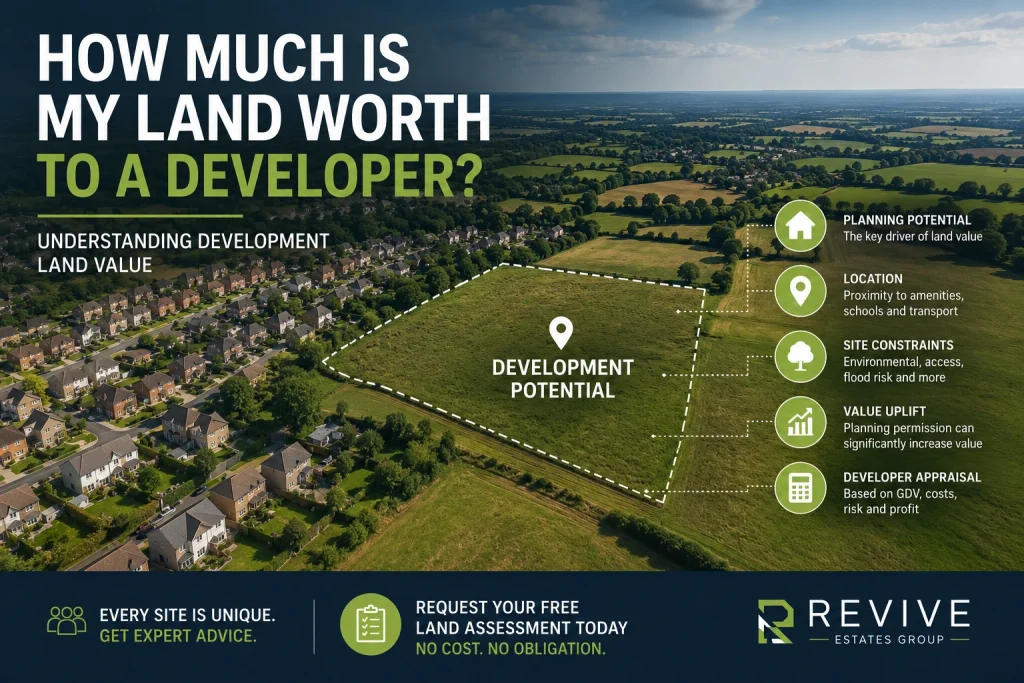
Development land is valued based on what could potentially be built on it, rather than simply what it is worth in its current use. Land with planning permission can be worth substantially more than the same land without it, although the uplift varies significantly from site to site. Location, planning policy, access, development potential and site constraints can all have a major effect on the value.
Many landowners know their land may have development potential, but one of the first questions they ask is:
“How much is my land worth to a developer?”
Unfortunately, there is no simple answer.
There is no single figure that applies to every site. A small parcel of land with strong development potential may be worth considerably more than a much larger site where planning permission is unlikely. The value depends on what can realistically be achieved, the value of the completed development, and the costs and risks involved in bringing the site forward.
In some cases, land worth only agricultural value today could be worth hundreds of thousands—or even millions—of pounds if it has genuine development potential and planning permission can be secured.
This guide explains how developers assess land, the factors that influence value, and how landowners can maximise the value of their land before selling.
Why Is Development Land Worth More Than Its Current Use?
Land with development potential can be worth considerably more than its current use value. An agricultural field, paddock, large garden or redundant building may have relatively modest value in its existing use, but if the site has realistic potential for residential or commercial development, its value can change significantly.
A developer is therefore not simply looking at what the land is worth today. They are assessing what could potentially be built, what the completed development might be worth, and what it will cost and risk to bring that development forward.
This is why two parcels of land of a similar size can have very different values. Planning policy, location, access, services, site constraints, development density and local property values can all affect the amount a developer may ultimately be prepared to pay.
What Determines Development Land Value?
Several factors influence how much a developer may be willing to pay for land.
Planning Permission
Planning permission is usually the single biggest factor affecting land value.
Land with planning permission for housing will generally be worth substantially more than land without consent.
For example, agricultural land may have relatively modest value in its existing use, while the same land with residential planning permission could be worth many hundreds of thousands of pounds per acre, depending on the location, number of homes, development costs and planning requirements.
Every site is different, but planning consent often creates the largest increase in value.
Location
Location remains critical.
Developers generally favour land that is:
- Close to existing settlements
- Within commuting distance of employment centres
- Near schools, shops and services
- Well connected by road and public transport
Sites in areas with strong housing demand can command higher values. Location is also important from a planning perspective. Land adjoining or close to an existing settlement may have different development potential from an isolated site in the countryside. Local planning policies, settlement boundaries, surrounding land uses and the availability of services can all influence both the prospects for development and the value a developer may place on the site.
Size Of The Site
Larger sites do not always mean higher values per acre.
Some smaller sites can be particularly attractive because:
- They are easier to develop.
- Planning risk may be lower.
- Build costs can be more predictable.
The amount of land is only one part of the equation. A smaller site may be worth more than a larger site if it can accommodate a more valuable or viable development. Developers will consider factors such as the number and type of properties that could potentially be built, the layout of the site, access, infrastructure and any planning or physical constraints.
Access
A site without suitable access may have limited development potential.
Developers will consider:
- Existing access arrangements
- Highway visibility
- Traffic impacts
- Potential improvements required
Access and infrastructure can have a significant effect on development value. Developers will consider whether suitable access can be achieved, the capacity of the surrounding highway network, and whether essential services such as water, electricity, drainage and telecommunications are available or can be provided at a reasonable cost. Where significant infrastructure works are required, these costs and risks can reduce the amount a developer is prepared to pay for the land.
Site Constraints
Developers assess any factors that could affect development.
Examples include:
- Flood risk
- Ecology issues
- Protected trees
- Listed buildings
- Rights of way
- Ground conditions
- Heritage designations
The fewer significant constraints a site has, the more attractive it may be to a developer. Where constraints do exist, the cost of investigating or overcoming them, together with the uncertainty they create, will be considered when assessing the site’s development potential and the amount a developer may be prepared to pay.
What Do Developers Actually Calculate?
When assessing land, developers typically work backwards from the value of the completed development.
This process is often known as a residual land valuation.
Gross Development Value (GDV)
The starting point is the expected value of the completed scheme.
For example:
If 20 new homes could be built and sold for £350,000 each:
Gross Development Value = £7,000,000
Development Costs
The developer then deducts:
- Construction costs
- Professional fees
- Planning costs
- Finance costs
- Infrastructure costs
- Section 106 contributions
- Community Infrastructure Levy (where applicable)
- Sales and marketing costs
These costs are deducted from the expected value of the completed development when assessing how much a developer can afford to pay for the land. The higher the costs, uncertainty or risk associated with bringing a site forward, the lower the residual land value may be.
Developer Profit
A developer will also require a profit margin to justify the risk involved. The required return will vary depending on the type of development, the risks involved, the funding required and the time it may take to complete the project.
Only after these costs have been deducted can the residual land value be established.
The residual land value provides an indication of what a developer may be able to justify paying for the site based on their particular appraisal and assumptions. Different developers may arrive at different figures because they may use different sales values, build costs, development strategies, profit requirements and assessments of risk.
The residual land value is therefore not simply a percentage of the property’s finished value or a standard price per acre. It is specific to the proposed development and the costs, risks and returns associated with bringing that particular site forward.
How Much Do Developers Pay for Land?
There is no standard amount that developers pay for land, and there is no reliable price per acre that applies to every site. The amount a developer may be prepared to pay depends on what can realistically be developed, the expected value of the completed scheme, the costs of bringing the site forward, the required developer profit and the risks involved.
In simple terms, a developer works backwards from the potential value of the completed development to establish what they can afford to pay for the land. This means a site with strong development potential may command a much higher price than another site of a similar size where planning, access or development costs create greater uncertainty.
It is therefore important not to judge an offer simply by comparing it with the price paid for another piece of land. Two sites that appear similar can have very different development values once planning prospects, housing numbers, sales values, infrastructure requirements and development costs are taken into account.
If a developer has approached you with an offer, understanding how they have arrived at their figure — and how that compares with the potential of your land — can put you in a much stronger position when deciding whether to accept, negotiate or explore other options.
How Much Is Development Land Worth Per Acre?
There is no standard price per acre for development land. The value can vary significantly depending on what can realistically be built, the location, planning position, development costs and the risks involved.
For example, two sites of the same size may have very different values if one can accommodate a larger or more valuable development, has better access and fewer constraints, or is located in an area with stronger demand.
This is why developers generally assess the overall development potential of a site rather than simply applying a price per acre. A price per acre can be useful when comparing sites, but it should not be treated as a reliable measure of the underlying development value.
If you are trying to establish the value of your own land, the more useful question is usually not “what is the price per acre?” but “what could this particular site realistically be worth to a developer?” That requires looking at the planning potential, possible development, expected values, costs and risks specific to the site.
Why Two Developers May Offer Different Prices
It is quite possible for two developers to look at the same piece of land and arrive at different figures. This does not necessarily mean that one developer is right and the other is wrong.
Developers may make different assumptions about the number of properties that could be built, the sales values they could achieve, construction costs, finance costs, the planning strategy and the level of profit they require.
They may also have different reasons for wanting the site. A developer operating locally may have a better understanding of the market, while another may have a particular need for sites in that area or a different approach to development.
This is one reason why it can be valuable for landowners to understand the potential of their land before accepting an offer. If you know what may be possible and understand the factors that influence development value, you are in a much stronger position to assess competing proposals and negotiate from an informed position.
What Makes a Developer Interested in Land?
Developers are generally looking for land where there is a realistic opportunity to create a viable development. The size of the site is only one part of the equation. Planning potential, location, access, market demand and the costs and risks of bringing the site forward can all influence whether a developer is interested.
Some of the factors that may make land attractive to a developer include:
- Planning potential — land with a realistic prospect of obtaining planning permission for residential or other development may be particularly attractive.
- A suitable location — proximity to existing settlements, services, transport links and areas of housing demand can all influence development potential.
- Good access — a site with suitable access to the public highway and potential for safe vehicle and pedestrian access may be easier to develop.
- A suitable site size and shape — the configuration of the land needs to work for the type of development being considered.
- Limited constraints — sites with fewer issues relating to flooding, ecology, heritage, highways, utilities or other constraints may be more straightforward to promote.
- Development demand — developers need to be confident that the completed properties or other development can be sold or occupied at values that support the scheme.
This is why land that appears ordinary to a landowner can sometimes be of significant interest to a developer. The important question is not simply what the land is currently used for, but whether there is a realistic development opportunity and whether that opportunity can be turned into a commercially viable scheme.
How Much More Is Land Worth With Planning Permission?
Planning permission can make a significant difference to the value of development land because it provides greater certainty about what can be built.
However, there is no fixed percentage or multiplier that can be applied to every site. The increase in value depends on what has been approved, how many properties can be built, the type and size of the development, expected sales values, development costs, planning obligations and the strength of the local market.
For some sites, obtaining planning permission can substantially increase the value because a developer is taking on less planning risk. For other sites, the increase may be more limited if the planning permission is for a less valuable scheme or significant development costs remain.
This is why landowners should be careful about assuming that planning permission automatically makes land worth a particular amount. The value ultimately depends on the economics of the development and what a developer can reasonably afford to pay after allowing for costs, risk and an appropriate profit.
If your land does not currently have planning permission, that does not necessarily mean that you have to sell it at its existing-use value. Depending on the site’s circumstances, exploring its planning potential before selling may provide an opportunity to increase its value.
Should I Sell My Land Without Planning Permission?
Yes, you can sell land without planning permission, and in some circumstances this may be the right option. However, if your land has realistic development potential, selling before exploring that potential could mean accepting less than the land may ultimately be worth.
The right approach depends on your priorities. Some landowners want a quick and certain sale, while others are prepared to wait and take some planning risk in the hope of achieving a higher value.
Selling Without Planning Permission
Advantages:
- Faster transaction
- Greater certainty
- Less involvement in the planning process
Disadvantages:
- The sale price may be lower
- The developer takes on the planning risk
- You may not benefit from some of the future increase in value created by planning
Exploring Planning Potential Before Selling
Potential advantages:
- Greater understanding of what the land could potentially be used for
- Potential to increase the value of the site
- A stronger negotiating position when dealing with developers
- More options when deciding how and when to sell
Potential disadvantages:
- Planning investigations and professional advice can involve costs
- There is no guarantee that planning permission will be obtained
- The process can take time
- You take on more of the planning risk
The important point is that you do not necessarily have to choose between selling immediately and pursuing a full planning application yourself. Depending on the site, options such as a land promotion agreement may allow you to explore planning potential while working with a specialist to manage the process.
Not sure which route is right for your land?
Whether you’re considering a quick sale, exploring planning options or wondering what your land could be worth, our free land assessment can help you understand your site’s potential and the options available to you.
Get My Free Land Assessment →No cost · No obligation · Reviewed personally by our team
What Types Of Land May Have Development Value?
Development value is not limited to land that already has planning permission. Different types of land can have development potential depending on their location, planning circumstances, existing use and the policies that apply to the site.
Examples can include:
- Greenfield land adjoining existing settlements — fields or other undeveloped land on the edge of towns and villages may have potential where planning policy and local circumstances support development. Find out more about strategic and greenfield land.
- Previously developed or brownfield land — land that has previously been developed can sometimes offer opportunities for redevelopment or conversion. Learn more about previously developed land.
- Large gardens — parts of larger residential gardens may have development potential, although planning policies, access and the character of the surrounding area need to be considered. Explore large garden development potential.
- Agricultural buildings and barns — some buildings may have potential for conversion under permitted development rights such as Class Q, subject to meeting the relevant requirements. Read our guide to Class Q barn conversions.
- Equestrian land and buildings — land associated with equestrian use may sometimes have alternative development or conversion potential depending on the site and planning circumstances. Explore equestrian development potential.
- Roadside land — land in prominent locations may have potential for uses such as drive-through facilities, EV charging or other commercial development where planning and access requirements can be satisfied. Learn more about roadside land opportunities.
- Land within the Green Belt — Green Belt land is subject to strong planning protections, but certain sites and circumstances may have development potential. Find out more about Green Belt land and development.
The important point is that the current use of the land does not necessarily tell you what it could be worth to a developer. A site that appears to have little value in its existing use may have significantly greater value if a realistic alternative use or development opportunity can be identified.
However, development potential should never be assumed simply because land falls into one of these categories. Each site needs to be considered on its own merits, taking account of planning policy, location, access, constraints and the likely economics of development.
How Can Landowners Maximise Land Value?
If your land has development potential, there may be several ways to improve the value you can achieve from it. The best approach will depend on the site, your objectives and how much time and risk you are prepared to take.
Understand the Planning Potential
Before agreeing to sell, establish what your land could realistically be used for and whether there is a credible prospect of obtaining planning permission. Understanding the planning position can help you avoid selling land based only on its existing use value.
Understand the Development Economics
Planning potential alone does not determine value. Consider what could potentially be built, the likely sales values, development costs, infrastructure requirements, planning obligations, finance and the return a developer would need to justify taking the project forward.
Consider Your Options
You do not necessarily have to sell your land immediately. Depending on the circumstances, you could consider selling without planning permission, pursuing planning yourself, appointing a land promoter, entering into an option agreement or exploring other development strategies.
Create Competition Where Appropriate
If several developers could be interested in the site, approaching more than one suitable buyer can help establish what the market is prepared to pay. Competition may also improve the terms available to you, although the most suitable buyer is not always the one offering the highest headline price.
Take Professional Advice
Development land transactions can involve significant sums and complex planning, financial and legal considerations. Taking appropriate professional advice before committing to a sale or long-term agreement can help you understand the risks, compare alternatives and make a more informed decision.
The key is to understand your land’s potential before deciding how to sell it. The more clearly you understand the opportunity, the stronger your position is likely to be when negotiating with developers or deciding which route to take.
The Biggest Mistake Landowners Make
The Biggest Mistake Landowners Make
One of the biggest mistakes a landowner can make is accepting an offer before fully understanding the site’s development potential.
If you’ve been approached by a developer, or you’re simply wondering what your land could realistically achieve, it is important to understand the options before committing to a sale.
Developers are experts at identifying opportunities. They assess land based on what they believe they can potentially develop and the return they can achieve from doing so. This means the price they offer needs to be considered in the context of the site’s potential value to them.
Before agreeing to sell, it is worth understanding:
- What the land could potentially become
- What planning opportunities may exist
- What constraints could affect development
- What alternative strategies may be available
- Whether other developers may be interested
A relatively small amount of investigation can sometimes make a significant difference to the decisions available to you. Understanding your land’s potential does not mean that you have to pursue planning or sell to a developer — it simply puts you in a stronger position to decide what is right for you.
Could your land be worth more than you think?
Every site is different. Our free land assessment looks at your site’s development potential, planning position, constraints and the options available to help you understand what your land could potentially be worth to a developer.
Get My Free Land Assessment →No cost · No obligation · Reviewed personally by our team